Food Movements & Culture
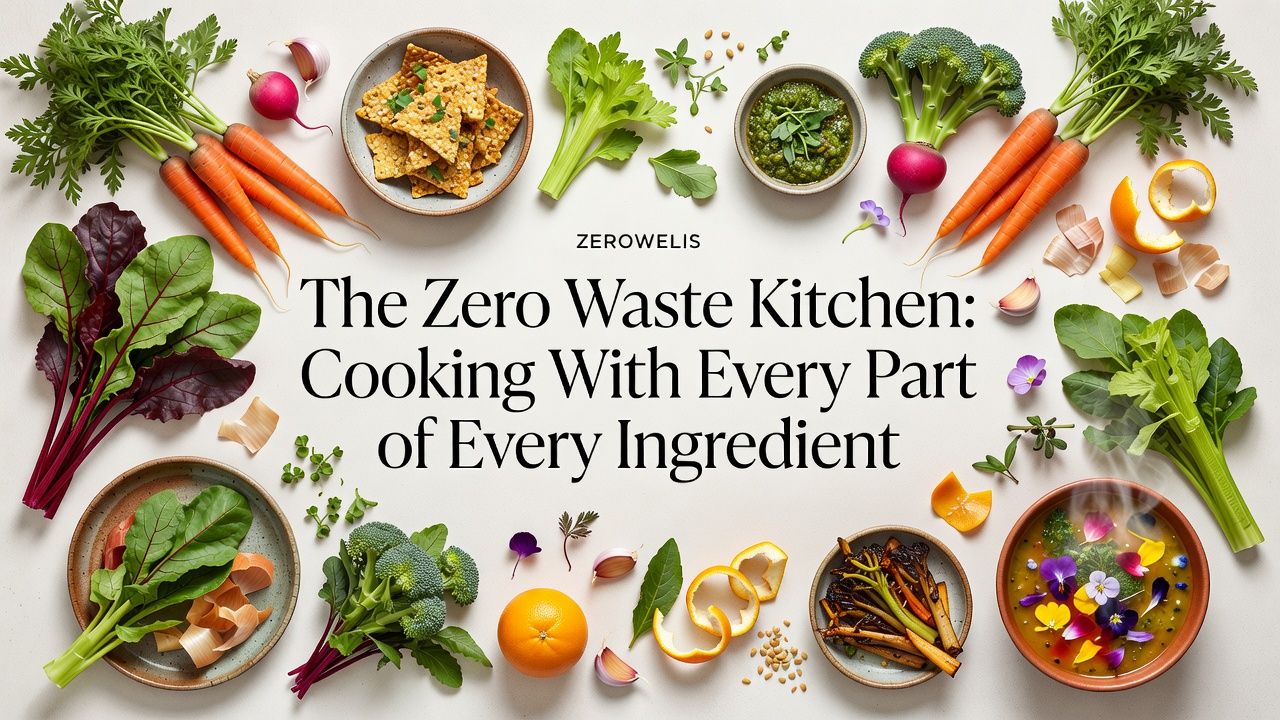
Broccoli stems, parmesan rinds, herb stalks, chicken bones, stale bread. The scraps you bin are, in most traditional cuisines, simply ingredients — and often the best ones.
A curious thing happened to home cooking in the twentieth century: it acquired a category called “scraps.” Broccoli stems became waste even though they’re sweeter than the florets. Herb stalks went in the bin even though they carry more flavor than the leaves. Chicken carcasses were thrown out rather than simmered. Stale bread was discarded rather than turned into any of the dozens of dishes built specifically around it. This is genuinely new behavior. For most of human history, and in most of the world’s cuisines still, the question was never whether to use a part of an ingredient but how, because nobody could afford the alternative.
The scale of what’s now thrown away is difficult to overstate. Food waste is one of the largest environmental problems in the developed world — discarded food represents wasted water, land, energy, labor and transport, and it generates significant greenhouse-gas emissions as it decomposes in landfill. A substantial share of that waste occurs not in fields or factories but in domestic kitchens. Agencies including the Environmental Protection Agency, the United States Department of Agriculture, and the UN’s Food and Agriculture Organization all treat reducing household food waste as one of the more accessible environmental interventions available to ordinary people. But the honest case for cooking this way isn’t only environmental. It saves real money, and — the part nobody expects — it makes food taste better, because the parts we’ve learned to discard are frequently the most flavorful parts of the ingredient.
Reframing: there are no scraps, only ingredients you haven’t identified
The mental shift required is small but total. Instead of asking “what do I throw away from this vegetable?”, ask “what can each part of this become?” Once you’re looking, the answers are everywhere, and most of them are genuinely delicious rather than dutiful.
| Usually binned | What it actually is |
|---|---|
| Broccoli & cauliflower stems | Sweet, crunchy vegetable — peel and slice for slaw, stir-fry, or roast |
| Carrot tops, radish & beet greens | Leafy greens — pesto, sautéed like chard, folded into soups |
| Herb stalks | Intensely flavored — blend into sauces, simmer in stock, chop into soffritto |
| Parmesan rinds | A savory bomb — simmer in soups, beans, sauces; remove before serving |
| Bones & carcasses | Stock — the base of half of classical cooking |
| Stale bread | Breadcrumbs, croutons, panzanella, ribollita, bread pudding, migas |
| Citrus peel | Zest for anything; candied peel; infused oils, sugars and vinegars |
| Pickle & ferment brine | Ready-made acidic seasoning for dressings and marinades |
| Bacon & roasting fat | Cooking fat with built-in flavor — strain and refrigerate |
Notice how many of these are flavor concentrates rather than sad substitutes. A parmesan rind dropped into a pot of beans does more for the dish than most seasonings you could buy. Herb stalks contain the same aromatic compounds as the leaves in higher concentration. Roasting-tin fat carries all the browned flavor of what you cooked in it. This is the part of zero-waste cooking that surprises people: you’re not compromising for virtue, you’re recovering ingredients that professional kitchens never stopped using.
Stock: the technique that absorbs almost everything
If you adopt one habit, make it the freezer stock bag. Keep a large bag or container in the freezer and add vegetable trimmings as you generate them — onion ends and skins, carrot peels and tops, celery leaves and bases, leek greens, herb stalks, mushroom stems, garlic skins. Keep a second bag for bones: chicken carcasses, the bones from chops, the shrimp shells from a stir-fry. When either is full, tip it into a pot, cover with water, simmer gently, and strain. You have just converted waste into the ingredient that improves every soup, risotto, braise and sauce you’ll make that month, for the cost of some water and an hour of unattended heat.
A few practical notes make it work better. Avoid brassica trimmings (broccoli, cabbage, cauliflower) in large quantities, since they turn stock sulfurous, and go easy on anything strongly bitter. Rinse vegetable trimmings before they go in the bag. Simmer gently rather than boiling hard, which keeps stock clear rather than cloudy. Don’t salt it — you don’t yet know what it will become, and an unsalted stock can be reduced without becoming inedible. Cool it promptly and refrigerate or freeze; freezing in flat bags or ice-cube trays gives you portions you can drop straight into a pan. Standard food-safety practice for cooling and storing cooked liquids applies, and clear guidance is available at FoodSafety.gov.
Use-it-up, not eat-anything
Reducing waste never means eating food that has actually spoiled. Discard anything mouldy, slimy, off-smelling, or past the point where you’re confident about it — and be especially conservative with cooked rice, cooked meats, and anything that’s been left out for hours. The goal is to stop good food being wasted, not to take risks with questionable food.
Prevention beats rescue: shopping and planning
The most effective waste reduction happens before anything reaches the kitchen. Most household food waste isn’t scraps at all — it’s whole items bought optimistically and never used: the bag of salad, the second bunch of herbs, the yogurt that got pushed to the back. No amount of clever scrap cookery compensates for over-buying, so the boring interventions are the powerful ones.
Shop your own kitchen first: before writing a list, look at what’s already in the fridge, freezer and pantry, and plan around it. Plan meals realistically for the week you’re actually going to have, including the evenings you know you’ll get takeaway, rather than for an idealized version of your schedule. Buy loose rather than pre-packaged where you can, so you take three carrots instead of a kilo bag. Be wary of bulk deals on perishables, which are only savings if everything gets eaten. And keep an “eat first” zone at eye level in the fridge for things approaching their limit — a five-second habit that redirects an enormous amount of food from the bin to the plate.
Understanding date labels helps too, since confusion about them drives significant unnecessary waste. “Use by” dates relate to safety and should be respected, particularly on high-risk foods. “Best before” and similar quality indicators relate to peak quality rather than safety, and many foods remain perfectly good afterwards — judged by sight and smell, and with common sense about what kind of food it is. Guidance on interpreting date labels is published by USDA Food Safety and Inspection Service, and it’s worth reading once so your judgments are informed rather than anxious.
Storage: making food last as long as it should
A significant portion of household waste is simply food that was stored badly and died early. Herbs kept upright in a glass of water like flowers, loosely covered, last for a week or more instead of collapsing in three days. Greens washed, dried thoroughly, and stored with a dry cloth to absorb moisture hold up far longer than greens left damp in a bag. Bread freezes beautifully sliced — take out what you need — while refrigerating it actually accelerates staling. Potatoes and onions want cool, dark, ventilated storage and should be kept apart from each other. Tomatoes and stone fruit lose flavor in the fridge and should sit out until ripe.
Preserving techniques extend this further and are worth having in the repertoire. Freezing is the easiest and most flexible: berries and chopped fruit for smoothies, blanched vegetables, herbs frozen in oil in ice-cube trays, leftover wine frozen for cooking, surplus stock in portions. Quick refrigerator pickles turn a surplus of cucumbers, carrots, or radishes into something that lasts weeks. Fermenting cabbage into sauerkraut does the same on a longer horizon. Drying herbs and chillies costs nothing but time. For anything involving canning or shelf-stable preservation, follow tested procedures from a reliable source — the National Center for Home Food Preservation publishes research-tested methods, and this is emphatically an area where improvising is unwise.
The dishes designed for leftovers
Every long-established cuisine contains a category of dishes whose entire purpose is using things up, and they are almost never apologetic — they’re some of the most beloved food in their traditions. Learning three or four of these templates means you never face a fridge of odds and ends without a plan.
| Template | Absorbs | Tradition |
|---|---|---|
| Frittata / tortilla | Any cooked vegetable, cheese ends, cooked potato, herbs | Italy, Spain |
| Fried rice / bibim-style bowls | Day-old rice, small amounts of vegetables and protein | Across East Asia |
| Bread soups & salads | Stale bread, tired vegetables, beans, stock | Tuscany (ribollita, panzanella) |
| Congee / rice porridge | Leftover rice, bones, scraps of meat, wilting greens | China and beyond |
| Curries & dals | Almost any vegetable, in almost any condition | South Asia |
| Soup & stew, generally | Everything — the universal solvent | Everywhere |
Two other habits close the loop. Cook once and plan the second life — roast chicken becomes sandwiches and then stock; a big pot of beans becomes soup, then a salad, then a spread. And compost what genuinely can’t be eaten, whether through a garden heap, a countertop bin, a municipal collection, or a community scheme, so that even true waste returns to soil rather than landfill.
Perhaps the most useful thing to say about zero-waste cooking is that “zero” is a direction rather than a standard to be achieved and felt guilty about missing. Nobody runs a household with literally no waste, and the perfectionist framing puts people off entirely. Start with the freezer stock bag, the eat-first fridge zone, and one leftover template you enjoy. Those three alone will noticeably cut what leaves your kitchen in bin bags and noticeably improve what comes out of your pans — because a cook who uses the whole ingredient is, almost by definition, cooking with more flavor than one who throws half of it away.