Category: Food Movements & Culture

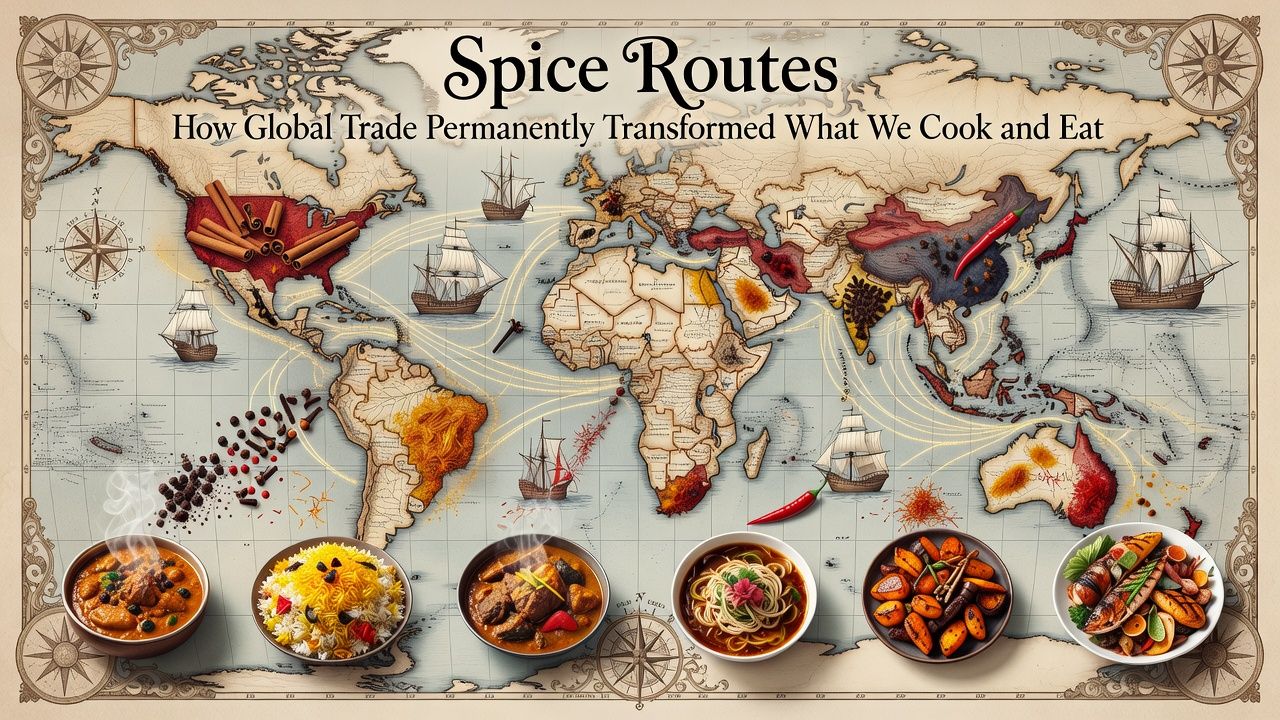
  • Spice Routes: How Global Trade Permanently Transformed What We Cook and Eat

    Spice Routes: How Global Trade Permanently Transformed What We Cook and Eat

    Global Culinary Traditions

    Italy without tomatoes. Thailand without chillies. India without potatoes. Almost every “traditional” cuisine you can name is a recent product of global trade — and the trade was rarely gentle.

    Here is a fact that reliably unsettles people: there were no tomatoes in Italy until the sixteenth century, no chillies in Thailand or India or Sichuan, no potatoes in Ireland, no chocolate anywhere outside the Americas, no vanilla in France. The dishes we think of as the deepest expressions of national identity — a Neapolitan pizza, a green curry, a Hungarian goulash, a Korean kimchi — are in historical terms fairly recent, and every one of them depends on ingredients that arrived by ship. What we experience as timeless tradition is, almost universally, the residue of trade.

    This is one of the more interesting things you can know about food, because it reframes cuisine as a record of movement rather than of isolation. It also carries a harder edge that a food article shouldn’t skip: the spice trade was not a benign exchange of interesting flavors. It drove exploration, conquest, colonization, monopoly violence, and slavery on an enormous scale, and the reason certain crops grow where they do is often the direct result of coerced labor and imperial policy. The pepper in your grinder has a history. Museums with substantial collections in this area — the British Museum, the Smithsonian, and botanical institutions like the Royal Botanic Gardens, Kew — document both the botany and the human cost, and both belong in the story.

    Why spices were worth killing for

    The old explanation — that medieval Europeans needed spices to disguise rotting meat — is essentially a myth, and worth discarding. Anyone who could afford pepper, nutmeg, or saffron could afford fresh meat. Spices were valuable for less practical reasons: they tasted of somewhere else, they were rare, they were believed to have medicinal properties, and their expense made them a display of status. In a world where most people ate a monotonous local diet their entire lives, a substance that transformed food and came from an unimaginable distance was worth a great deal.

    The economics were extraordinary. Certain spices grew in very restricted places — nutmeg and mace originally only in a small island group in eastern Indonesia, cloves similarly — and passed through long chains of intermediaries across Asia and the Middle East before reaching European markets, with each link multiplying the price. Whoever controlled the source, or the route, controlled a fortune. That’s the engine behind a remarkable amount of world history: the overland Silk Road networks, the maritime spice routes across the Indian Ocean, the Portuguese voyages around Africa seeking to bypass intermediaries, Columbus sailing west in search of a shortcut to the spice islands and finding a continent instead, and the chartered trading companies that followed — organizations that raised armies, seized territory, and behaved as states. Colonization of much of the world was, in significant part, a spice-procurement strategy.

    Spice Origin Where it ended up central
    Black pepper Southern India Essentially everywhere — the default seasoning worldwide
    Cinnamon & cassia Sri Lanka; southern China Middle Eastern savory cooking; European baking
    Nutmeg & cloves Eastern Indonesian islands European preserving and baking; Indian masalas
    Chilli The Americas India, Thailand, Sichuan, Korea, Hungary, West Africa
    Vanilla Mesoamerica European and global confectionery
    Ginger & turmeric South and Southeast Asia Across Asia, the Middle East, the Caribbean

    The Columbian Exchange: the biggest food event in history

    If spices drove the ships, the consequence that actually rewrote the world’s cooking was the exchange of crops between the Americas and everywhere else after 1492 — a biological transfer of such scale that historians gave it its own name. Its effects on cuisine are almost comically large, and once you know them, a great deal of “authentic traditional cooking” looks different.

    From the Americas Transformed
    Tomato Italian and Spanish cooking; unimaginable without it now
    Chilli Indian, Thai, Sichuan, Korean, Hungarian, West African cooking
    Potato Northern European diets and populations, profoundly
    Maize African, southern European and Asian staple cooking
    Cacao, vanilla, peanut Global confectionery; West African and Southeast Asian cooking
    Squash, beans, avocado Mediterranean, African and Asian vegetable repertoires

    Traffic ran the other way too — wheat, rice, sugar cane, coffee, citrus, bananas, cattle, pigs, and chickens all crossed to the Americas, reshaping agriculture and diet there as comprehensively. And the darker consequences travelled with them. Sugar cane plantations in the Caribbean and Brazil were built on the transatlantic slave trade; coffee, cacao, and later rubber followed similar patterns of coerced labor. The globalization of ingredients and the globalization of exploitation are the same history, and the reason a particular crop dominates a particular region today is frequently a colonial decision rather than an ecological one.

    The chilli, in one paragraph

    Chillies reached Asia via Portuguese traders in the sixteenth century. Within a few generations they had been absorbed so completely into Indian, Thai, Sichuan, and Korean cooking that each now seems unthinkable without them — and each developed its own varieties, preparations, and role for the ingredient. It’s the clearest case study in how fast a cuisine can absorb something foreign and make it definitively its own.

    What “authentic” means after you know this

    The obvious implication is that culinary authenticity is a much slipperier idea than it’s usually treated as. Every cuisine is a snapshot of a process still running — a particular arrangement of borrowed ingredients and adapted techniques that happened to stabilize long enough to feel permanent. Neapolitan pizza is “traditional” and depends on an American fruit. Sichuan cooking is unmistakably itself and depends on an American plant. Irish potato dishes, Hungarian paprika, Thai curry pastes, Korean gochujang — all of them are fusion food that has been around long enough to stop being called that.

    This doesn’t make authenticity meaningless, but it does relocate it. What makes a dish authentically Sichuan isn’t that its ingredients are indigenous — it’s the technique, the balance, the role the dish plays in a meal, the accumulated knowledge of the people who cook it. Authenticity is about coherence and craft rather than about origin. That’s a more generous and more accurate frame, and it also makes the modern anxiety about fusion cooking look a little odd: fusion is not a contemporary invention but the ordinary mechanism by which every cuisine on earth came to exist.

    Where a real distinction survives is between adoption and appropriation, and it’s mostly about credit and reciprocity. Cuisines have always borrowed; what’s newer is the situation where a dish is borrowed, stripped of its context, sold at a premium, and credited to the borrower while the originating community sees no benefit. The historical record makes that pattern easier to recognize, since it’s structurally the same asymmetry that ran through the spice trade itself.

    Using spices better, in practice

    The practical payoff of all this history is that spices, once astronomically expensive, are now cheap and universally available — and most home cooks still use them badly. Three habits fix the majority of the problem.

    Buy whole and grind as needed. Ground spices lose their volatile aromatic compounds relatively quickly — a matter of months rather than years — while whole spices hold them far longer. A cheap electric grinder or a mortar transforms the flavor of everything you cook with them, and the difference between freshly ground cumin and a jar of grey powder that’s been open two years is not subtle.

    Bloom them in fat or toast them dry. Most spice aromatics are fat-soluble, which means adding them to hot oil at the start of cooking extracts far more than stirring them into a watery liquid. This is the logic of the South Asian tadka or tarka — whole spices sizzled in hot fat and poured over a dish — and of the toasting step in countless traditions. Thirty seconds of heat before liquid goes in changes the character of the whole dish.

    Store them properly. Cool, dark, airtight, and away from the hob — the rack mounted above the stove is the traditional and worst possible location, since heat accelerates the loss of exactly what you’re paying for. Buy small quantities more often rather than large jars you’ll use twice a year, and apply a periodic smell test: a spice with no aroma will contribute no flavor, and no amount compensates.

    Beyond technique, there’s a broader invitation in the history. If your spice cupboard contains cumin, cinnamon, paprika, and little else, you’re using a fraction of what centuries of violent, extraordinary global exchange has made available for a few pounds. Buying a spice you don’t know and learning what a cuisine does with it — not just sprinkling it on things, but understanding its role — is one of the cheapest ways to expand what you can cook.

    And it’s worth holding both halves of the history at once. The pepper, cinnamon, and chilli in an ordinary kitchen cupboard are the end products of a story containing genuine wonder — ships crossing unknown oceans, plants transplanted across hemispheres, cuisines reinventing themselves in a generation — and genuine atrocity, including empires built and populations enslaved to control these exact substances. Knowing that doesn’t spoil dinner. It just makes the spice rack a more interesting object than it looked, and makes the enormous, borrowed, endlessly recombined inheritance that constitutes every cuisine on earth a little harder to take for granted.
  • Foraging for the Modern Cook: Finding Wild Ingredients in Urban and Rural Settings

    Foraging for the Modern Cook: Finding Wild Ingredients in Urban and Rural Settings

    Food Movements & Culture

    Wild food is genuinely rewarding and genuinely risky. This is a guide to starting responsibly — with expert instruction, legal permission, and a healthy respect for what you don’t yet know.

    Read this first

    This article is an introduction to foraging as a practice, not a field guide and not an identification resource. Never eat any wild plant or fungus unless its identity has been confirmed beyond doubt by a qualified expert. Some species are lethally toxic and closely resemble edible ones. If you suspect poisoning, contact emergency services or a poison control centre immediately — in the United States, information and contact details are at poison.org.

    There is something genuinely compelling about wild food. Part of it is flavor — wild garlic, elderflower, sea buckthorn, chanterelles and their like taste of things that no cultivated equivalent quite replicates, and many simply cannot be bought at any price. Part of it is the shift in attention: once you start looking, a familiar park or hedgerow stops being scenery and becomes a landscape full of specific, named, seasonal things. And part of it is continuity with something very old, since foraging is how humans ate for the overwhelming majority of our history and remains a living tradition in a great many places.

    It is also the single riskiest activity covered anywhere in home cooking, and it deserves to be treated that way rather than as a charming weekend hobby. Misidentification of wild fungi and plants causes serious poisonings and deaths every year, and the reason is not carelessness so much as overconfidence: several of the most dangerous species look quite ordinary and resemble things people believe they recognize. This article therefore spends its first half on how to start safely and its second on what you actually do with wild ingredients — because the enjoyable part is only available to people who get the serious part right first.

    The rules that aren’t negotiable

    Experienced foragers converge on a small set of absolute rules, and none of them have exceptions for enthusiasm.

    Certainty or nothing. If you are not one hundred percent certain of an identification — not “fairly sure,” not “it matches the photo” — you do not eat it. There is no partial credit. This applies with particular force to fungi, where several deadly species are unremarkable-looking and where the onset of the most dangerous poisonings can be delayed by many hours, so that a person feels fine long after the damage has begun.

    Learn from people, not from apps. Plant-identification apps and image searches are useful for narrowing possibilities and completely inadequate as a basis for eating something. They misidentify regularly, they cannot assess the features that actually distinguish species (spore prints, gill attachment, smell, habitat, growth pattern), and they offer false confidence precisely where confidence is most dangerous. The correct route is instruction from experienced foragers, local mycological societies, and guided walks — organizations such as the North American Mycological Association maintain networks of regional clubs, identification volunteers, and educational events, and equivalent societies exist in most countries.

    There is no universal test. The folk shortcuts — that animals avoid poisonous plants, that toxic mushrooms tarnish silver, that boiling removes toxins, that anything growing on wood is safe — are all false, and believing any of them is a well-documented route to hospital. Identification is species-by-species and feature-by-feature, and that is the only method that works.

    Start with a very short list. The sensible beginner approach is to learn a handful of distinctive, low-risk species extremely well before adding anything, and to have every early find checked by someone qualified. Even then, introduce a new wild food in a small quantity the first time, since individual sensitivities and allergic reactions exist independently of whether a species is generally edible.

    Risk Why it’s serious The only real mitigation
    Misidentification Some species are lethal; some look-alikes are close Expert confirmation, every time, before eating
    Delayed symptoms Feeling fine hours later does not mean it was safe Seek medical help immediately on any suspicion
    Contamination Roadsides, sprayed verges, industrial land, dog-walked areas Choose clean sites; avoid verges and treated ground
    Improper preparation Some edible species require thorough cooking Follow species-specific expert guidance
    Individual reaction Allergies and sensitivities vary between people Small first portion; one new species at a time

    Legality and permission

    Foraging law varies enormously by country, region, and even by individual site, and assuming you may pick something because it’s growing outdoors is a reliable way to break rules you didn’t know existed. Many national parks and protected areas prohibit or tightly restrict collecting; the National Park Service, for example, publishes site-specific rules that differ from park to park. Nature reserves often prohibit it entirely. Private land requires the landowner’s permission. Some jurisdictions distinguish between picking small quantities for personal use and commercial collection; others regulate specific protected species that must not be picked at all.

    The workable approach is to check the rules for the specific place before you go, not after, and to default to caution. Local authorities, land managers, agriculture and conservation departments, and foraging groups can all point you at the relevant regulations. Botanical resources such as the USDA’s PLANTS Database are useful for understanding what grows in a region and which species carry protected or invasive status, though they are reference tools rather than edibility guides.

    Foraging ethically

    Wild food has become fashionable, and popular sites near cities now show real damage from over-collection. The ethical guidelines that experienced foragers observe exist because a wild population that gets stripped doesn’t return. Take only a modest share of what’s present at any one site, leaving plenty for wildlife, for other people, and for the plant or fungus to reproduce. Never take rare, protected, or locally scarce species. Harvest in ways that don’t destroy the organism — cutting rather than uprooting where appropriate, minimizing disturbance to the ground and surrounding habitat.

    Spread your impact rather than returning repeatedly to the same patch, tread carefully, and leave sites as you found them. Be thoughtful about publicizing precise locations of productive or sensitive spots, since a single popular post can strip a site in a season. And keep the whole enterprise in proportion: foraging is a supplement to how you eat, not a food supply, and treating it as a source of quantity rather than of occasional quality is what causes the damage.

    Where to look, and what the seasons offer

    Wild food is not confined to wilderness. Urban and suburban environments — parks, allotments, waste ground, hedgerows, garden margins, coastal paths — support a surprising amount of it, with the important caveat that contamination is a genuine urban concern. Avoid road verges (traffic pollution and runoff), areas that may be sprayed with herbicide, industrial or formerly industrial land, and paths heavily used by dogs. Choose sites away from these, and wash everything thoroughly regardless.

    The rhythm of a foraging year is one of its pleasures, and it varies by region and climate — the table below is a general shape rather than a schedule, and what’s available and legal where you live may differ considerably.

    Season Typically the season for
    Early spring Young leaves and shoots; wild alliums; the first tender greens
    Late spring Flowers and blossom; nettle tops; early fungi in some regions
    Summer Soft fruits and berries; coastal plants; herbs at their peak
    Autumn The main fungi season; nuts; hedgerow fruits and hips
    Winter Quiet — some hardy greens, a few tree fungi, mostly a reading season

    Cooking wild ingredients

    Assuming everything above has been observed and you’re holding something properly identified, the cooking principles are refreshingly simple. Wild flavors tend to be more intense, more bitter, more aromatic and more variable than their cultivated counterparts, so the first rule is restraint: treat a wild ingredient as the centre of a simple dish rather than one element of a complicated one, and taste as you go, since the same species can vary considerably by site and season.

    Wild greens generally suit the same treatments as cultivated ones — sautéed with garlic and oil, wilted into soups, blitzed into pesto-style sauces — but often benefit from a fat and an acid to balance bitterness. Wild fungi should be cooked thoroughly (many edible species are unsuitable raw and some require specific preparation), cleaned by brushing rather than soaking so they don’t waterlog, and cooked in a hot dry pan first to drive off moisture before fat goes in. Wild fruits and berries are typically more acidic and more variable in sweetness than shop-bought equivalents, which makes them excellent for jams, cordials, syrups, vinegars and infusions where you control the sugar.

    Preservation is worth learning because wild food arrives in gluts. Drying, freezing, infusing in oil or vinegar, and pickling all extend a short season. For anything involving canning or shelf-stable preservation, follow research-tested procedures — the National Center for Home Food Preservation publishes them, and improvising here compounds risk on top of risk. Keep foraged material clearly labeled and separate in the fridge, and be scrupulous about not mixing an unconfirmed find with food you’re going to eat.

    How to actually begin

    The responsible on-ramp looks like this. Find a local guided foraging walk or a mycological society and go on one before you pick anything — a few hours with someone experienced teaches more, and more safely, than a season of reading. Buy a good regional field guide written for your specific area, since species and look-alikes differ enormously by geography, and use it alongside expert input rather than instead of it. Learn two or three distinctive species thoroughly in your first year, in all their stages and with their look-alikes clearly understood, rather than accumulating a long shallow list. Have your finds checked. Keep notes and photographs of where and when you found things.

    And hold onto the perspective that makes this worthwhile rather than fraught: the value of foraging is not really the food. It’s the attention. Learning to identify even a few wild species permanently changes how you see the ordinary landscape you walk through — the verge, the park, the hedge become specific and legible and seasonal, populated by things with names. That shift is available to anyone, immediately, and costs nothing. The eating is a bonus, earned slowly, with expert help, and with a healthy respect for the fact that the natural world contains a great many things that are not food and a few that will hurt you badly. Learn carefully, take little, check everything, and enjoy it.

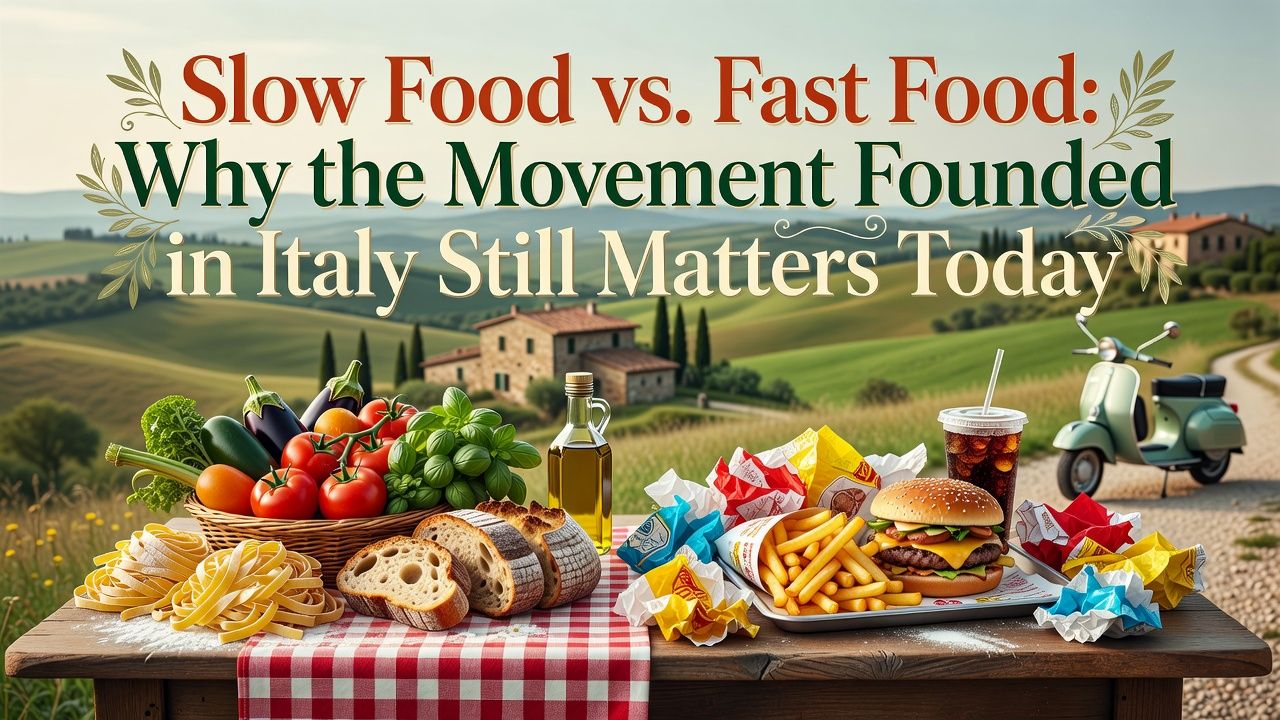
  • Slow Food vs. Fast Food: Why the Movement Founded in Italy Still Matters Today

    Slow Food vs. Fast Food: Why the Movement Founded in Italy Still Matters Today

    Food Movements & Culture

    It began as a protest against a burger chain near the Spanish Steps. Four decades on, its actual argument — good, clean, fair — has aged better than almost anyone expected.

    The founding story is almost too neat. In the mid-1980s, plans for a McDonald’s near Rome’s Spanish Steps prompted a protest, and out of it grew an organization with a deliberately provocative name: Slow Food. Founded in Italy by Carlo Petrini, the movement signed its international manifesto in Paris at the end of the decade and has since grown into a global network active in more than 160 countries, working, in its own formulation, for food that is good, clean, and fair for all. Its own account of that history is at slowfood.com.

    It’s easy to caricature. “Slow Food” sounds like an invitation to spend six hours on dinner, or like nostalgia dressed as politics — a movement of people with time and money lecturing people with neither. Some of that criticism has landed fairly over the years. But the underlying argument is more substantial and considerably more durable than the name suggests, and it was never really about cooking times. It was about what gets lost when food becomes a standardized industrial commodity: local varieties, regional techniques, the economic viability of small producers, the knowledge held by the people who grow things, and the social function of eating together. Four decades on, with biodiversity loss, farm consolidation, and the erosion of regional foodways all well documented, the movement’s founding worries look less like romanticism than like early warning.

    Good, clean, and fair: what the three words actually mean

    The movement’s core formulation compresses its whole philosophy into three criteria, each doing distinct work. Good refers to quality, flavor, and cultural appropriateness — food that tastes of something, made in ways that suit its place. Clean refers to production that doesn’t damage the environment, animal welfare, or human health. Fair refers to accessible prices for consumers and just conditions and pay for producers. The third is the one most often forgotten by people who encounter the movement through restaurant menus, and it’s the one that most clearly distinguishes it from a purely aesthetic interest in nice ingredients.

    Set against this is the industrial food model the movement formed in opposition to — not “fast food” narrowly as burgers and fries, but the broader logic of standardization, scale, speed, and cost minimization applied to eating. That system has genuine achievements to its name, and any honest account has to say so: it made calories cheap and abundant, reduced the share of household income spent on food dramatically, improved certain aspects of food safety through regulation and cold chains, and made a huge variety of foods available year-round to people who could never have had them before. These are not small things. The critique isn’t that industrial food is worthless; it’s that its costs have been externalized and under-counted.

    Dimension Industrial model Slow Food position
    Priority Speed, scale, low unit cost Quality, provenance, sustainability
    Variety Few standardized cultivars and breeds Regional diversity; endangered varieties preserved
    Producer Anonymous; squeezed on price Named; paid fairly; knowledge respected
    Eating Individual, convenient, often alone Shared, attentive, social
    Strength Genuine: affordability, availability, convenience Genuine: flavor, culture, producer livelihoods
    Weakness Externalized environmental and social costs Cost and time barriers; risk of elitism

    Biodiversity: the argument that has aged best

    Of everything the movement raised early, the biodiversity argument has proved the most substantive. Industrial agriculture concentrates on a small number of high-yielding, shipping-tolerant, uniform varieties, and the consequence over decades has been the disappearance of enormous numbers of local cultivars, heritage animal breeds, and traditional food products — each representing generations of adaptation to a specific place and a distinctive set of flavors that simply cease to exist when the last grower stops. International bodies including the Food and Agriculture Organization have documented the narrowing of the genetic base underpinning the global food supply, and the resilience implications are not merely sentimental: uniform crops are uniformly vulnerable.

    Slow Food’s practical response has been unusually concrete for a movement often accused of being philosophical. Its “Ark of Taste” catalogues endangered foods — varieties, breeds, and traditional products at risk of disappearing — and its Presidia projects work directly with small producer communities to keep specific products economically viable. The logic is straightforward: the most effective way to preserve a heritage variety is to create a market for it, so that growing it pays. This is conservation through consumption rather than through museums, and it has kept a meaningful number of foods in production that would otherwise have gone.

    The cultural dimension runs alongside it. Traditional foodways are knowledge systems — how to make a particular cheese, cure a particular ham, ferment a particular vegetable — and they die when they stop being practiced, not when they stop being written down. UNESCO’s recognition of various culinary traditions as intangible cultural heritage, catalogued at ich.unesco.org, reflects the same understanding: that food practices carry cultural memory and are genuinely losable.

    Slow doesn’t mean long

    The name refers to attention, not duration. A ten-minute plate of good pasta with real olive oil, eaten at a table with other people and no screen, is closer to the movement’s actual argument than a four-hour braise eaten alone over a laptop.

    The criticisms, taken seriously

    A fair treatment has to engage with the objections, because several are strong. The most serious is the accessibility critique: cooking from scratch with high-quality ingredients requires time, money, equipment, skill, and often transport — resources unevenly distributed. For someone working two jobs, or living in an area with poor food retail, or lacking a functional kitchen, advice to shop at farmers’ markets and cook slowly can read as oblivious at best. When the movement’s ideas surface primarily through expensive restaurants and lifestyle media, the “fair” leg of its own tripod starts looking neglected.

    There’s also a nostalgia critique worth weighing: traditional food systems were not uniformly wonderful. They involved genuine hardship, seasonal scarcity, monotonous diets, adulteration, and food-safety problems that modern regulation and refrigeration largely solved. Romanticizing the pre-industrial past requires forgetting a good deal about it. And a related practical objection: for a growing global population, questions of yield, affordability, and food security are real, and a purely artisanal model doesn’t obviously answer them at scale.

    The movement’s better advocates accept much of this, and its work has increasingly moved toward food access, school food education, indigenous food sovereignty, and youth networks rather than gastronomy alone. The defensible position isn’t that everyone should eat artisanal food all the time — it’s that a food system optimized purely for cheapness and speed produces predictable damage, that some of that damage is irreversible, and that consumers who do have choices exercise real influence over which producers survive.

    What it means in an ordinary week

    Stripped of ideology, the movement’s practical implications for a normal household are modest and mostly free. They’re less about what you buy than about paying attention.

    Practice Why it matters Cost
    Eat at a table, with others, without screens The social core of the whole idea Free
    Cook from raw ingredients a few times a week Usually cheaper than convenience food; builds skill Time
    Buy seasonally Better flavor, lower price, lighter footprint Usually saves money
    Buy directly from a producer occasionally More of the price reaches the grower Varies
    Learn one regional dish properly Keeps technique and tradition in circulation Free
    Waste less The highest-impact, lowest-cost change available Saves money

    The eating-together element deserves more weight than it usually gets. A great deal of the movement’s original complaint was about the atomization of meals — food consumed alone, quickly, while doing something else — and the loss of the table as a social institution. This is the part that costs nothing and is available to almost everyone regardless of budget: sitting down, with other people, giving the meal your attention for twenty minutes. Whatever one thinks about heritage cultivars, that argument has only strengthened in an era of delivery apps and desk lunches.

    Which is roughly where a reasonable person can land. Slow Food is not a rule requiring anyone to abandon convenience, and treating it as an identity to perform misses the point as thoroughly as dismissing it does. Its durable contribution is a set of questions worth asking occasionally — where did this come from, who made it, were they paid properly, does it taste of anything, am I actually paying attention while I eat it? Ask those a few times a week and buy accordingly when you can. That’s not a lifestyle. It’s just noticing, which turns out to be what the movement was arguing for all along.

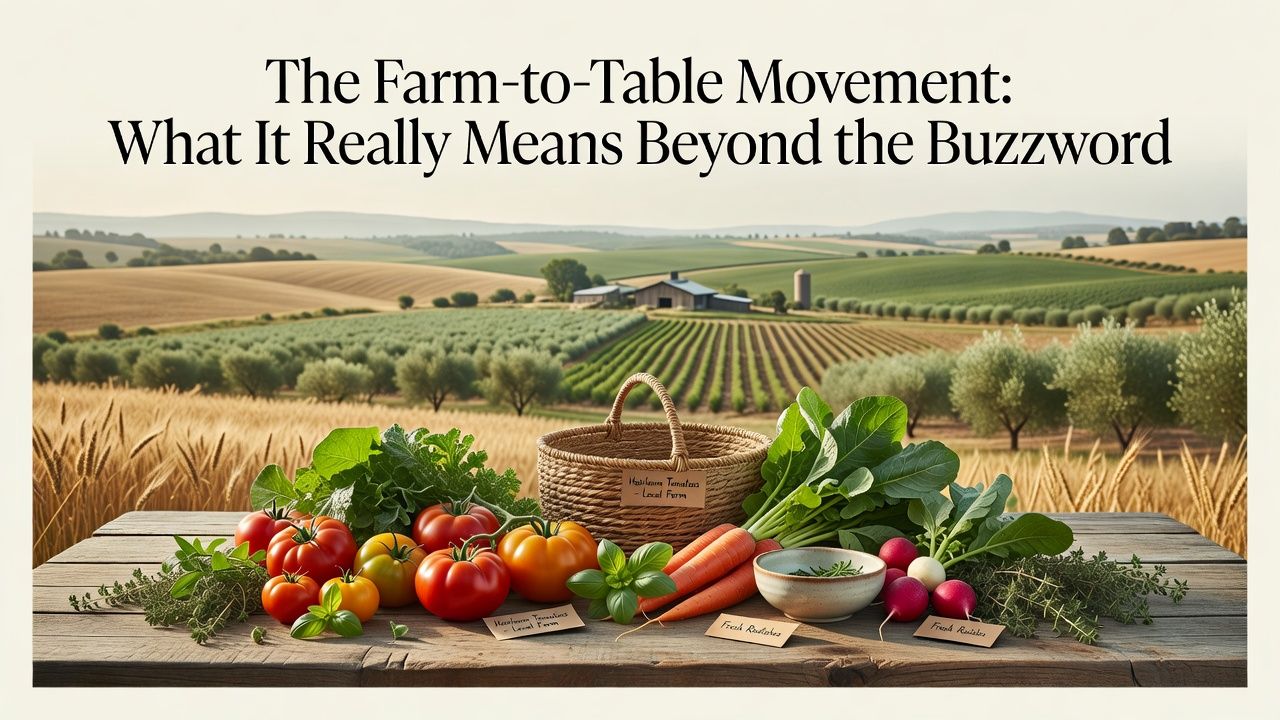
  • The Farm-to-Table Movement: What It Really Means Beyond the Buzzword

    The Farm-to-Table Movement: What It Really Means Beyond the Buzzword

    Food Movements & Culture

    The phrase now appears on menus at chains that source from national distributors. Here’s what it originally meant, what’s genuinely valuable in it, and how to tell the real thing from the marketing.

    “Farm-to-table” has had the career trajectory of most successful food ideas: born as a genuine reform, adopted by serious restaurants, then absorbed by marketing departments until it appears in the window of establishments buying frozen ingredients from national distributors. The phrase is now so diluted that it’s tempting to dismiss it altogether. That would be a mistake, because underneath the branding sits a set of real ideas about how food gets from soil to plate, some of which are demonstrably valuable and some of which are more complicated than their advocates admit.

    This piece tries to do three things: explain what the movement originally meant and where it came from, examine honestly which of its claims hold up and which are oversold, and offer practical ways to participate that don’t require living near a famous restaurant or spending a fortune. The short version, if you want it now: the strongest arguments for eating this way are about flavor, seasonality, and the health of local food economies, and those arguments are good ones. The arguments about environmental impact and nutrition are real but considerably more nuanced than the marketing suggests, and pretending otherwise does the movement no favors.

    Where the idea came from

    The modern movement emerged in the 1970s as a reaction against an industrialized food system that had, over a few post-war decades, made food cheap, abundant, and strikingly disconnected from where it grew. Produce was bred for shipping durability and shelf life rather than flavor; supply chains stretched across continents; supermarket tomatoes in February became normal and nobody could remember what a good one tasted like. A number of chefs — the movement is often traced to Californian restaurants that built menus around what local farmers had picked that week — began building relationships directly with growers and letting the season, rather than a fixed menu, dictate what they cooked.

    It ran parallel to related movements internationally, most notably Slow Food, founded in Italy in the 1980s in defense of local food cultures and traditional production against the standardizing pressure of fast food; the organization’s international work is documented at slowfood.com. Different origins, overlapping instincts: that shortening the distance between grower and eater improves food, that seasonality is a feature rather than a limitation, and that knowing who produced your food changes your relationship with it. In its original form, farm-to-table was less a cuisine than a sourcing philosophy — a decision about where the ingredients come from, which then reshapes everything downstream.

    The claims, examined honestly

    Advocates make several arguments for local, seasonal sourcing. They vary considerably in strength, and being clear-eyed about which is which makes for a more defensible position than accepting the whole package.

    Claim How it holds up
    Better flavor Strong. Produce picked ripe and eaten soon after, and varieties chosen for taste rather than shipping durability, genuinely taste better
    Supports local economies Strong. Direct sales return a far larger share of the price to the grower than conventional retail chains
    Preserves varieties & farmland Reasonable. Direct markets sustain heirloom varieties and small farms that commodity channels won’t carry
    More nutritious Partly. Some nutrients do decline after harvest, but the effect varies by crop and handling — and frozen produce, picked and frozen at peak, often compares well
    Lower environmental impact Complicated. Transport is usually a small share of a food’s total footprint; production method often matters more than distance

    That last row deserves expanding, because “food miles” is the movement’s most repeated and least reliable argument. For most foods, the great majority of environmental impact comes from how something was produced — land use, fertilizer, water, energy inputs, methane from livestock — rather than from how far it travelled, and long-distance shipping by sea is remarkably efficient per kilogram. This produces genuinely counterintuitive results: produce grown in a heated greenhouse nearby can carry a larger footprint than the same crop grown in season in a suitable climate and shipped. Meanwhile air-freighted produce is a real exception, carrying a very high transport footprint. None of this makes local sourcing pointless — it just means the strongest environmental argument is for eating seasonally and eating in ways that suit the land, rather than for distance alone. Analyses of food-system sustainability from the Food and Agriculture Organization consistently point to production practices, diet composition, and waste as the dominant variables.

    Seasonal beats local

    If you have to choose one principle, choose seasonality. Food grown in its natural season, in a climate that suits it, tends to taste better, cost less, and carry a lighter footprint than the same thing forced out of season nearby. Local and seasonal together is ideal; seasonal alone is still excellent.

    The buzzword problem

    There is no legal definition of “farm-to-table,” which means anyone can print it on a menu. Investigative reporting in various cities has repeatedly found restaurants advertising local sourcing while buying from conventional wholesale distributors, naming farms that don’t supply them, or sourcing a single garnish locally and describing the whole operation accordingly. This isn’t universal, but it’s common enough that skepticism is warranted, and the fuzziness extends to the word “local” itself — which might mean fifteen kilometres or five hundred depending on who’s using it.

    The tells for genuine practice are reasonably consistent. Real farm-to-table restaurants name specific farms rather than gesturing vaguely at “local producers.” Their menus change with the seasons, often frequently, because they’re cooking what’s actually available — a menu that offers the same tomato dish in January and July is telling you something. They’re generally happy to answer sourcing questions in detail. And they tend to work with a limited number of dishes rather than an enormous menu, since genuinely seasonal sourcing constrains what you can reliably offer. There’s also a fair criticism worth acknowledging: farm-to-table dining has often been expensive and exclusive, functioning as a luxury signifier rather than a food-system reform, which sits awkwardly with the movement’s stated values.

    Doing it yourself, affordably

    Here’s the useful reframing: the home cook is better positioned to practice this than almost any restaurant, and can do it cheaply. Buying directly from producers cuts out intermediaries, and in-season produce at a farmers’ market is frequently less expensive than out-of-season equivalents at a supermarket, not more — the expensive version of farm-to-table is a restaurant meal, not a bag of carrots.

    Route What it gives you Trade-off
    Farmers’ market Direct contact, peak-season produce, variety Fixed times; not all stalls are growers — ask
    CSA / veg box scheme A share of a farm’s harvest, delivered regularly You cook what arrives, not what you planned
    Farm shops & pick-your-own Lowest prices at peak; a day out Requires transport and timing
    Local butcher, baker, fishmonger Provenance information and better handling Often pricier per kilo than supermarket
    Growing something yourself Herbs, tomatoes, salad — the shortest chain possible Time, space, and a learning curve

    A few habits make direct buying work. Learn what’s actually in season where you live — extension services and agriculture departments publish regional seasonality guides, and the USDA maintains public information on farmers’ markets and local food programs. Shop with flexibility rather than a rigid list, buying what looks best and deciding dinner afterwards; this is the single biggest mental adjustment and the one that makes seasonal cooking enjoyable rather than frustrating. Talk to the person selling — growers will tell you what’s at its peak this week, what’s coming, and how they’d cook it, which is information no supermarket provides. Buy in gluts and preserve: freeze, pickle, or make sauce when something is abundant and cheap.

    Cooking the farm-to-table way

    The cooking philosophy that follows from this sourcing is refreshingly simple: when ingredients are genuinely good, do less to them. A tomato picked ripe in August needs salt and olive oil, not a sauce. Peak asparagus wants butter and lemon. This is the ingredient-led approach shared by many of the world’s most respected cuisines, and it means seasonal cooking is often easier than the alternative, not harder. It also inverts the usual order of operations — instead of choosing a recipe and shopping for it, you buy what’s best and then decide what to make, which requires a small repertoire of flexible techniques rather than a library of specific recipes.

    The rhythm this produces is one of the underrated pleasures of eating seasonally. Strawberries in early summer, tomatoes and stone fruit at the height of it, squash and roots and brassicas in autumn and winter, the first asparagus and peas in spring — food regains a calendar, and each thing becomes something to anticipate rather than a permanent, mediocre fixture. Eating tomatoes only when they’re good is a smaller sacrifice than it sounds and a genuine gain in pleasure.

    Where this leaves the honest reader is somewhere less absolute than the marketing but more useful. Farm-to-table’s core insight — that shortening the chain between grower and eater produces better food and healthier local economies — is sound. Its environmental arguments are real but need care, since production method and seasonality matter more than distance. Its restaurant expression has often been more expensive and more performative than its principles warrant. And the best version available to most people isn’t dining out at all: it’s buying something in season from someone who grew it, cooking it simply, and noticing the difference. Do that a few times a month, without any purity about the rest, and you’ll have captured nearly all of what the movement was actually for.

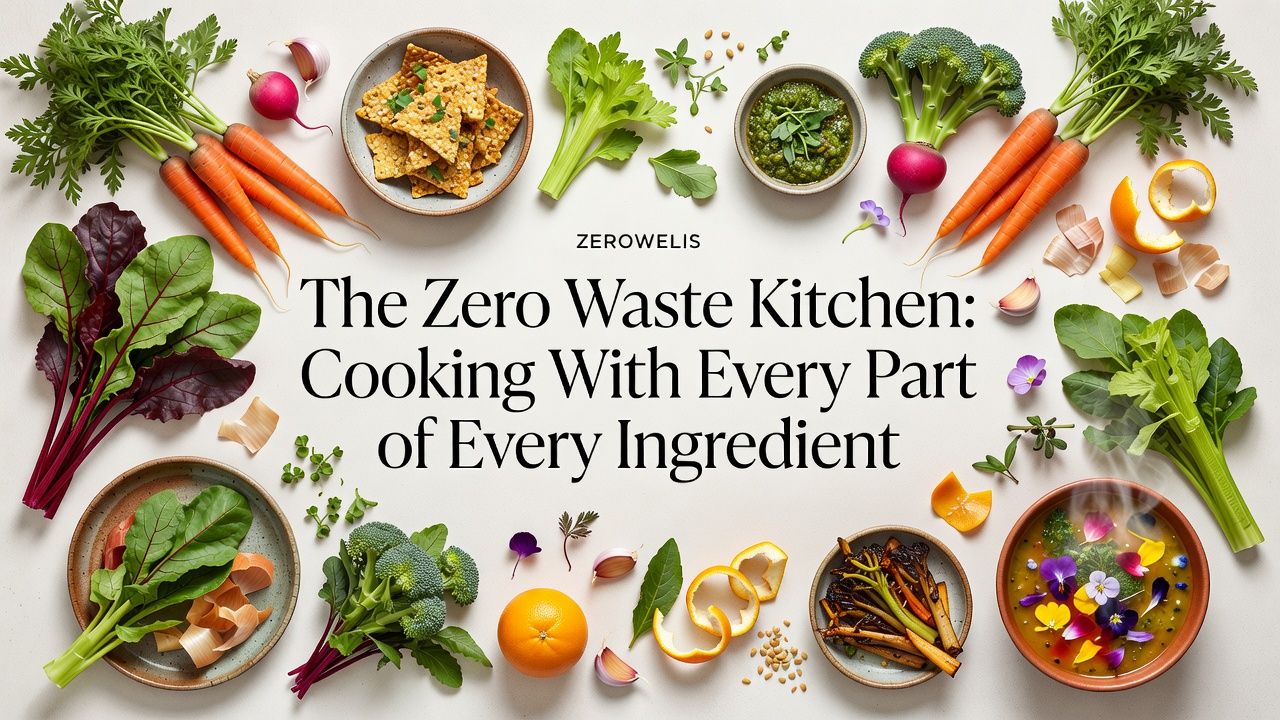
  • The Zero Waste Kitchen: Cooking With Every Part of Every Ingredient

    The Zero Waste Kitchen: Cooking With Every Part of Every Ingredient

    Food Movements & Culture

    Broccoli stems, parmesan rinds, herb stalks, chicken bones, stale bread. The scraps you bin are, in most traditional cuisines, simply ingredients — and often the best ones.

    A curious thing happened to home cooking in the twentieth century: it acquired a category called “scraps.” Broccoli stems became waste even though they’re sweeter than the florets. Herb stalks went in the bin even though they carry more flavor than the leaves. Chicken carcasses were thrown out rather than simmered. Stale bread was discarded rather than turned into any of the dozens of dishes built specifically around it. This is genuinely new behavior. For most of human history, and in most of the world’s cuisines still, the question was never whether to use a part of an ingredient but how, because nobody could afford the alternative.

    The scale of what’s now thrown away is difficult to overstate. Food waste is one of the largest environmental problems in the developed world — discarded food represents wasted water, land, energy, labor and transport, and it generates significant greenhouse-gas emissions as it decomposes in landfill. A substantial share of that waste occurs not in fields or factories but in domestic kitchens. Agencies including the Environmental Protection Agency, the United States Department of Agriculture, and the UN’s Food and Agriculture Organization all treat reducing household food waste as one of the more accessible environmental interventions available to ordinary people. But the honest case for cooking this way isn’t only environmental. It saves real money, and — the part nobody expects — it makes food taste better, because the parts we’ve learned to discard are frequently the most flavorful parts of the ingredient.

    Reframing: there are no scraps, only ingredients you haven’t identified

    The mental shift required is small but total. Instead of asking “what do I throw away from this vegetable?”, ask “what can each part of this become?” Once you’re looking, the answers are everywhere, and most of them are genuinely delicious rather than dutiful.

    Usually binned What it actually is
    Broccoli & cauliflower stems Sweet, crunchy vegetable — peel and slice for slaw, stir-fry, or roast
    Carrot tops, radish & beet greens Leafy greens — pesto, sautéed like chard, folded into soups
    Herb stalks Intensely flavored — blend into sauces, simmer in stock, chop into soffritto
    Parmesan rinds A savory bomb — simmer in soups, beans, sauces; remove before serving
    Bones & carcasses Stock — the base of half of classical cooking
    Stale bread Breadcrumbs, croutons, panzanella, ribollita, bread pudding, migas
    Citrus peel Zest for anything; candied peel; infused oils, sugars and vinegars
    Pickle & ferment brine Ready-made acidic seasoning for dressings and marinades
    Bacon & roasting fat Cooking fat with built-in flavor — strain and refrigerate

    Notice how many of these are flavor concentrates rather than sad substitutes. A parmesan rind dropped into a pot of beans does more for the dish than most seasonings you could buy. Herb stalks contain the same aromatic compounds as the leaves in higher concentration. Roasting-tin fat carries all the browned flavor of what you cooked in it. This is the part of zero-waste cooking that surprises people: you’re not compromising for virtue, you’re recovering ingredients that professional kitchens never stopped using.

    Stock: the technique that absorbs almost everything

    If you adopt one habit, make it the freezer stock bag. Keep a large bag or container in the freezer and add vegetable trimmings as you generate them — onion ends and skins, carrot peels and tops, celery leaves and bases, leek greens, herb stalks, mushroom stems, garlic skins. Keep a second bag for bones: chicken carcasses, the bones from chops, the shrimp shells from a stir-fry. When either is full, tip it into a pot, cover with water, simmer gently, and strain. You have just converted waste into the ingredient that improves every soup, risotto, braise and sauce you’ll make that month, for the cost of some water and an hour of unattended heat.

    A few practical notes make it work better. Avoid brassica trimmings (broccoli, cabbage, cauliflower) in large quantities, since they turn stock sulfurous, and go easy on anything strongly bitter. Rinse vegetable trimmings before they go in the bag. Simmer gently rather than boiling hard, which keeps stock clear rather than cloudy. Don’t salt it — you don’t yet know what it will become, and an unsalted stock can be reduced without becoming inedible. Cool it promptly and refrigerate or freeze; freezing in flat bags or ice-cube trays gives you portions you can drop straight into a pan. Standard food-safety practice for cooling and storing cooked liquids applies, and clear guidance is available at FoodSafety.gov.

    Use-it-up, not eat-anything

    Reducing waste never means eating food that has actually spoiled. Discard anything mouldy, slimy, off-smelling, or past the point where you’re confident about it — and be especially conservative with cooked rice, cooked meats, and anything that’s been left out for hours. The goal is to stop good food being wasted, not to take risks with questionable food.

    Prevention beats rescue: shopping and planning

    The most effective waste reduction happens before anything reaches the kitchen. Most household food waste isn’t scraps at all — it’s whole items bought optimistically and never used: the bag of salad, the second bunch of herbs, the yogurt that got pushed to the back. No amount of clever scrap cookery compensates for over-buying, so the boring interventions are the powerful ones.

    Shop your own kitchen first: before writing a list, look at what’s already in the fridge, freezer and pantry, and plan around it. Plan meals realistically for the week you’re actually going to have, including the evenings you know you’ll get takeaway, rather than for an idealized version of your schedule. Buy loose rather than pre-packaged where you can, so you take three carrots instead of a kilo bag. Be wary of bulk deals on perishables, which are only savings if everything gets eaten. And keep an “eat first” zone at eye level in the fridge for things approaching their limit — a five-second habit that redirects an enormous amount of food from the bin to the plate.

    Understanding date labels helps too, since confusion about them drives significant unnecessary waste. “Use by” dates relate to safety and should be respected, particularly on high-risk foods. “Best before” and similar quality indicators relate to peak quality rather than safety, and many foods remain perfectly good afterwards — judged by sight and smell, and with common sense about what kind of food it is. Guidance on interpreting date labels is published by USDA Food Safety and Inspection Service, and it’s worth reading once so your judgments are informed rather than anxious.

    Storage: making food last as long as it should

    A significant portion of household waste is simply food that was stored badly and died early. Herbs kept upright in a glass of water like flowers, loosely covered, last for a week or more instead of collapsing in three days. Greens washed, dried thoroughly, and stored with a dry cloth to absorb moisture hold up far longer than greens left damp in a bag. Bread freezes beautifully sliced — take out what you need — while refrigerating it actually accelerates staling. Potatoes and onions want cool, dark, ventilated storage and should be kept apart from each other. Tomatoes and stone fruit lose flavor in the fridge and should sit out until ripe.

    Preserving techniques extend this further and are worth having in the repertoire. Freezing is the easiest and most flexible: berries and chopped fruit for smoothies, blanched vegetables, herbs frozen in oil in ice-cube trays, leftover wine frozen for cooking, surplus stock in portions. Quick refrigerator pickles turn a surplus of cucumbers, carrots, or radishes into something that lasts weeks. Fermenting cabbage into sauerkraut does the same on a longer horizon. Drying herbs and chillies costs nothing but time. For anything involving canning or shelf-stable preservation, follow tested procedures from a reliable source — the National Center for Home Food Preservation publishes research-tested methods, and this is emphatically an area where improvising is unwise.

    The dishes designed for leftovers

    Every long-established cuisine contains a category of dishes whose entire purpose is using things up, and they are almost never apologetic — they’re some of the most beloved food in their traditions. Learning three or four of these templates means you never face a fridge of odds and ends without a plan.

    Template Absorbs Tradition
    Frittata / tortilla Any cooked vegetable, cheese ends, cooked potato, herbs Italy, Spain
    Fried rice / bibim-style bowls Day-old rice, small amounts of vegetables and protein Across East Asia
    Bread soups & salads Stale bread, tired vegetables, beans, stock Tuscany (ribollita, panzanella)
    Congee / rice porridge Leftover rice, bones, scraps of meat, wilting greens China and beyond
    Curries & dals Almost any vegetable, in almost any condition South Asia
    Soup & stew, generally Everything — the universal solvent Everywhere

    Two other habits close the loop. Cook once and plan the second life — roast chicken becomes sandwiches and then stock; a big pot of beans becomes soup, then a salad, then a spread. And compost what genuinely can’t be eaten, whether through a garden heap, a countertop bin, a municipal collection, or a community scheme, so that even true waste returns to soil rather than landfill.

    Perhaps the most useful thing to say about zero-waste cooking is that “zero” is a direction rather than a standard to be achieved and felt guilty about missing. Nobody runs a household with literally no waste, and the perfectionist framing puts people off entirely. Start with the freezer stock bag, the eat-first fridge zone, and one leftover template you enjoy. Those three alone will noticeably cut what leaves your kitchen in bin bags and noticeably improve what comes out of your pans — because a cook who uses the whole ingredient is, almost by definition, cooking with more flavor than one who throws half of it away.