Global Culinary Traditions
Italy without tomatoes. Thailand without chillies. India without potatoes. Almost every “traditional” cuisine you can name is a recent product of global trade — and the trade was rarely gentle.
Here is a fact that reliably unsettles people: there were no tomatoes in Italy until the sixteenth century, no chillies in Thailand or India or Sichuan, no potatoes in Ireland, no chocolate anywhere outside the Americas, no vanilla in France. The dishes we think of as the deepest expressions of national identity — a Neapolitan pizza, a green curry, a Hungarian goulash, a Korean kimchi — are in historical terms fairly recent, and every one of them depends on ingredients that arrived by ship. What we experience as timeless tradition is, almost universally, the residue of trade.
This is one of the more interesting things you can know about food, because it reframes cuisine as a record of movement rather than of isolation. It also carries a harder edge that a food article shouldn’t skip: the spice trade was not a benign exchange of interesting flavors. It drove exploration, conquest, colonization, monopoly violence, and slavery on an enormous scale, and the reason certain crops grow where they do is often the direct result of coerced labor and imperial policy. The pepper in your grinder has a history. Museums with substantial collections in this area — the British Museum, the Smithsonian, and botanical institutions like the Royal Botanic Gardens, Kew — document both the botany and the human cost, and both belong in the story.
Why spices were worth killing for
The old explanation — that medieval Europeans needed spices to disguise rotting meat — is essentially a myth, and worth discarding. Anyone who could afford pepper, nutmeg, or saffron could afford fresh meat. Spices were valuable for less practical reasons: they tasted of somewhere else, they were rare, they were believed to have medicinal properties, and their expense made them a display of status. In a world where most people ate a monotonous local diet their entire lives, a substance that transformed food and came from an unimaginable distance was worth a great deal.
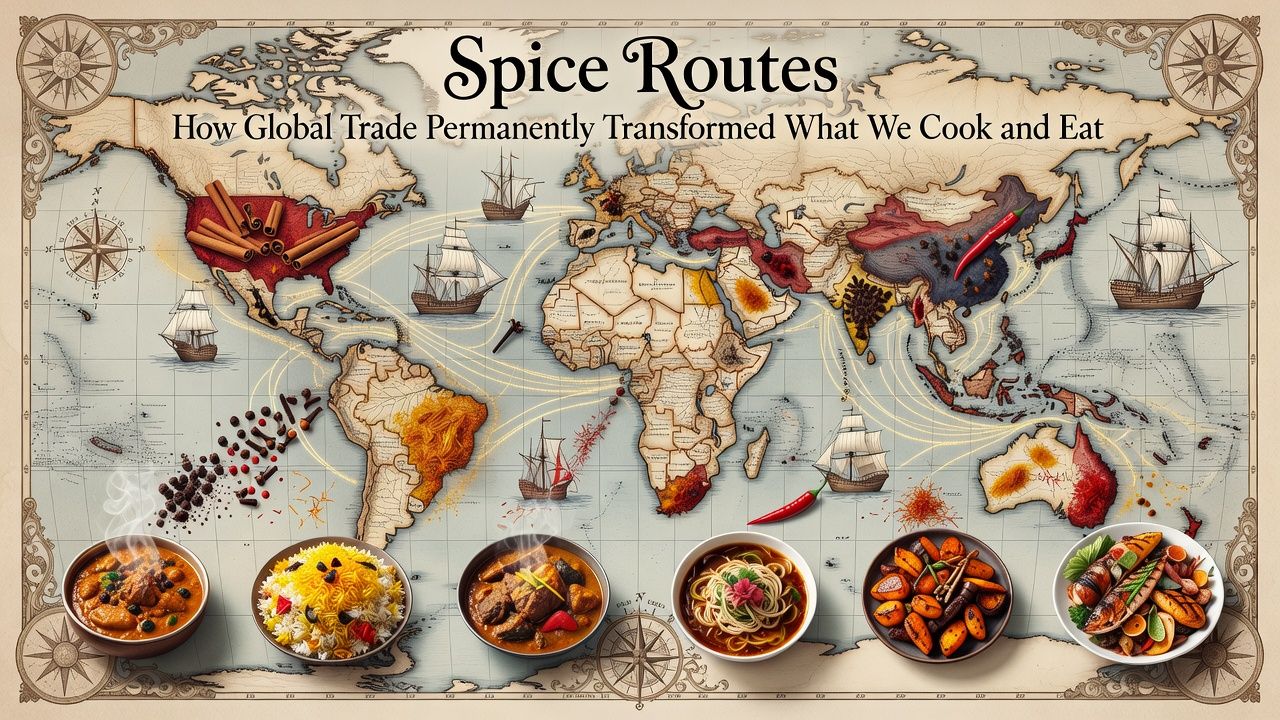
The economics were extraordinary. Certain spices grew in very restricted places — nutmeg and mace originally only in a small island group in eastern Indonesia, cloves similarly — and passed through long chains of intermediaries across Asia and the Middle East before reaching European markets, with each link multiplying the price. Whoever controlled the source, or the route, controlled a fortune. That’s the engine behind a remarkable amount of world history: the overland Silk Road networks, the maritime spice routes across the Indian Ocean, the Portuguese voyages around Africa seeking to bypass intermediaries, Columbus sailing west in search of a shortcut to the spice islands and finding a continent instead, and the chartered trading companies that followed — organizations that raised armies, seized territory, and behaved as states. Colonization of much of the world was, in significant part, a spice-procurement strategy.
| Spice | Origin | Where it ended up central |
|---|---|---|
| Black pepper | Southern India | Essentially everywhere — the default seasoning worldwide |
| Cinnamon & cassia | Sri Lanka; southern China | Middle Eastern savory cooking; European baking |
| Nutmeg & cloves | Eastern Indonesian islands | European preserving and baking; Indian masalas |
| Chilli | The Americas | India, Thailand, Sichuan, Korea, Hungary, West Africa |
| Vanilla | Mesoamerica | European and global confectionery |
| Ginger & turmeric | South and Southeast Asia | Across Asia, the Middle East, the Caribbean |
The Columbian Exchange: the biggest food event in history
If spices drove the ships, the consequence that actually rewrote the world’s cooking was the exchange of crops between the Americas and everywhere else after 1492 — a biological transfer of such scale that historians gave it its own name. Its effects on cuisine are almost comically large, and once you know them, a great deal of “authentic traditional cooking” looks different.
| From the Americas | Transformed |
|---|---|
| Tomato | Italian and Spanish cooking; unimaginable without it now |
| Chilli | Indian, Thai, Sichuan, Korean, Hungarian, West African cooking |
| Potato | Northern European diets and populations, profoundly |
| Maize | African, southern European and Asian staple cooking |
| Cacao, vanilla, peanut | Global confectionery; West African and Southeast Asian cooking |
| Squash, beans, avocado | Mediterranean, African and Asian vegetable repertoires |
Traffic ran the other way too — wheat, rice, sugar cane, coffee, citrus, bananas, cattle, pigs, and chickens all crossed to the Americas, reshaping agriculture and diet there as comprehensively. And the darker consequences travelled with them. Sugar cane plantations in the Caribbean and Brazil were built on the transatlantic slave trade; coffee, cacao, and later rubber followed similar patterns of coerced labor. The globalization of ingredients and the globalization of exploitation are the same history, and the reason a particular crop dominates a particular region today is frequently a colonial decision rather than an ecological one.
The chilli, in one paragraph
Chillies reached Asia via Portuguese traders in the sixteenth century. Within a few generations they had been absorbed so completely into Indian, Thai, Sichuan, and Korean cooking that each now seems unthinkable without them — and each developed its own varieties, preparations, and role for the ingredient. It’s the clearest case study in how fast a cuisine can absorb something foreign and make it definitively its own.
What “authentic” means after you know this
The obvious implication is that culinary authenticity is a much slipperier idea than it’s usually treated as. Every cuisine is a snapshot of a process still running — a particular arrangement of borrowed ingredients and adapted techniques that happened to stabilize long enough to feel permanent. Neapolitan pizza is “traditional” and depends on an American fruit. Sichuan cooking is unmistakably itself and depends on an American plant. Irish potato dishes, Hungarian paprika, Thai curry pastes, Korean gochujang — all of them are fusion food that has been around long enough to stop being called that.
This doesn’t make authenticity meaningless, but it does relocate it. What makes a dish authentically Sichuan isn’t that its ingredients are indigenous — it’s the technique, the balance, the role the dish plays in a meal, the accumulated knowledge of the people who cook it. Authenticity is about coherence and craft rather than about origin. That’s a more generous and more accurate frame, and it also makes the modern anxiety about fusion cooking look a little odd: fusion is not a contemporary invention but the ordinary mechanism by which every cuisine on earth came to exist.
Where a real distinction survives is between adoption and appropriation, and it’s mostly about credit and reciprocity. Cuisines have always borrowed; what’s newer is the situation where a dish is borrowed, stripped of its context, sold at a premium, and credited to the borrower while the originating community sees no benefit. The historical record makes that pattern easier to recognize, since it’s structurally the same asymmetry that ran through the spice trade itself.
Using spices better, in practice
The practical payoff of all this history is that spices, once astronomically expensive, are now cheap and universally available — and most home cooks still use them badly. Three habits fix the majority of the problem.
Buy whole and grind as needed. Ground spices lose their volatile aromatic compounds relatively quickly — a matter of months rather than years — while whole spices hold them far longer. A cheap electric grinder or a mortar transforms the flavor of everything you cook with them, and the difference between freshly ground cumin and a jar of grey powder that’s been open two years is not subtle.
Bloom them in fat or toast them dry. Most spice aromatics are fat-soluble, which means adding them to hot oil at the start of cooking extracts far more than stirring them into a watery liquid. This is the logic of the South Asian tadka or tarka — whole spices sizzled in hot fat and poured over a dish — and of the toasting step in countless traditions. Thirty seconds of heat before liquid goes in changes the character of the whole dish.
Store them properly. Cool, dark, airtight, and away from the hob — the rack mounted above the stove is the traditional and worst possible location, since heat accelerates the loss of exactly what you’re paying for. Buy small quantities more often rather than large jars you’ll use twice a year, and apply a periodic smell test: a spice with no aroma will contribute no flavor, and no amount compensates.
Beyond technique, there’s a broader invitation in the history. If your spice cupboard contains cumin, cinnamon, paprika, and little else, you’re using a fraction of what centuries of violent, extraordinary global exchange has made available for a few pounds. Buying a spice you don’t know and learning what a cuisine does with it — not just sprinkling it on things, but understanding its role — is one of the cheapest ways to expand what you can cook.
And it’s worth holding both halves of the history at once. The pepper, cinnamon, and chilli in an ordinary kitchen cupboard are the end products of a story containing genuine wonder — ships crossing unknown oceans, plants transplanted across hemispheres, cuisines reinventing themselves in a generation — and genuine atrocity, including empires built and populations enslaved to control these exact substances. Knowing that doesn’t spoil dinner. It just makes the spice rack a more interesting object than it looked, and makes the enormous, borrowed, endlessly recombined inheritance that constitutes every cuisine on earth a little harder to take for granted.