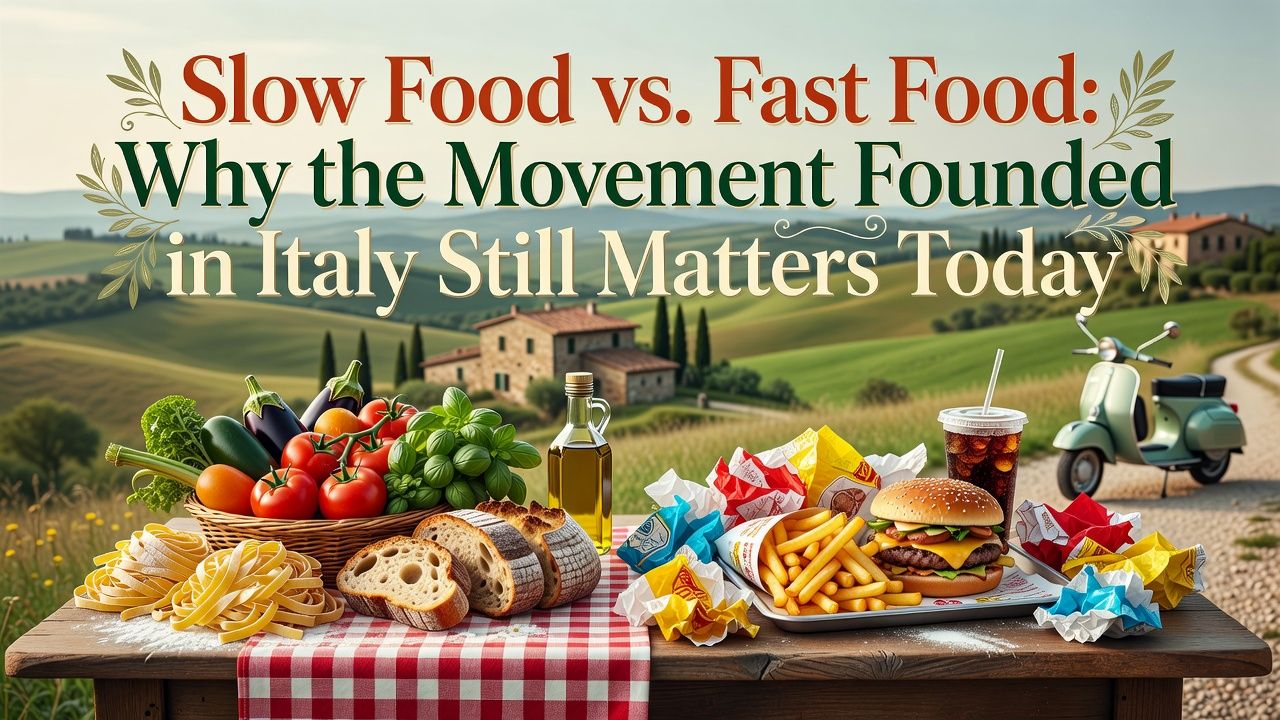
Food Movements & Culture
It began as a protest against a burger chain near the Spanish Steps. Four decades on, its actual argument — good, clean, fair — has aged better than almost anyone expected.
The founding story is almost too neat. In the mid-1980s, plans for a McDonald’s near Rome’s Spanish Steps prompted a protest, and out of it grew an organization with a deliberately provocative name: Slow Food. Founded in Italy by Carlo Petrini, the movement signed its international manifesto in Paris at the end of the decade and has since grown into a global network active in more than 160 countries, working, in its own formulation, for food that is good, clean, and fair for all. Its own account of that history is at slowfood.com.
It’s easy to caricature. “Slow Food” sounds like an invitation to spend six hours on dinner, or like nostalgia dressed as politics — a movement of people with time and money lecturing people with neither. Some of that criticism has landed fairly over the years. But the underlying argument is more substantial and considerably more durable than the name suggests, and it was never really about cooking times. It was about what gets lost when food becomes a standardized industrial commodity: local varieties, regional techniques, the economic viability of small producers, the knowledge held by the people who grow things, and the social function of eating together. Four decades on, with biodiversity loss, farm consolidation, and the erosion of regional foodways all well documented, the movement’s founding worries look less like romanticism than like early warning.
Good, clean, and fair: what the three words actually mean
The movement’s core formulation compresses its whole philosophy into three criteria, each doing distinct work. Good refers to quality, flavor, and cultural appropriateness — food that tastes of something, made in ways that suit its place. Clean refers to production that doesn’t damage the environment, animal welfare, or human health. Fair refers to accessible prices for consumers and just conditions and pay for producers. The third is the one most often forgotten by people who encounter the movement through restaurant menus, and it’s the one that most clearly distinguishes it from a purely aesthetic interest in nice ingredients.
Set against this is the industrial food model the movement formed in opposition to — not “fast food” narrowly as burgers and fries, but the broader logic of standardization, scale, speed, and cost minimization applied to eating. That system has genuine achievements to its name, and any honest account has to say so: it made calories cheap and abundant, reduced the share of household income spent on food dramatically, improved certain aspects of food safety through regulation and cold chains, and made a huge variety of foods available year-round to people who could never have had them before. These are not small things. The critique isn’t that industrial food is worthless; it’s that its costs have been externalized and under-counted.
| Dimension | Industrial model | Slow Food position |
|---|---|---|
| Priority | Speed, scale, low unit cost | Quality, provenance, sustainability |
| Variety | Few standardized cultivars and breeds | Regional diversity; endangered varieties preserved |
| Producer | Anonymous; squeezed on price | Named; paid fairly; knowledge respected |
| Eating | Individual, convenient, often alone | Shared, attentive, social |
| Strength | Genuine: affordability, availability, convenience | Genuine: flavor, culture, producer livelihoods |
| Weakness | Externalized environmental and social costs | Cost and time barriers; risk of elitism |
Biodiversity: the argument that has aged best
Of everything the movement raised early, the biodiversity argument has proved the most substantive. Industrial agriculture concentrates on a small number of high-yielding, shipping-tolerant, uniform varieties, and the consequence over decades has been the disappearance of enormous numbers of local cultivars, heritage animal breeds, and traditional food products — each representing generations of adaptation to a specific place and a distinctive set of flavors that simply cease to exist when the last grower stops. International bodies including the Food and Agriculture Organization have documented the narrowing of the genetic base underpinning the global food supply, and the resilience implications are not merely sentimental: uniform crops are uniformly vulnerable.
Slow Food’s practical response has been unusually concrete for a movement often accused of being philosophical. Its “Ark of Taste” catalogues endangered foods — varieties, breeds, and traditional products at risk of disappearing — and its Presidia projects work directly with small producer communities to keep specific products economically viable. The logic is straightforward: the most effective way to preserve a heritage variety is to create a market for it, so that growing it pays. This is conservation through consumption rather than through museums, and it has kept a meaningful number of foods in production that would otherwise have gone.
The cultural dimension runs alongside it. Traditional foodways are knowledge systems — how to make a particular cheese, cure a particular ham, ferment a particular vegetable — and they die when they stop being practiced, not when they stop being written down. UNESCO’s recognition of various culinary traditions as intangible cultural heritage, catalogued at ich.unesco.org, reflects the same understanding: that food practices carry cultural memory and are genuinely losable.
Slow doesn’t mean long
The name refers to attention, not duration. A ten-minute plate of good pasta with real olive oil, eaten at a table with other people and no screen, is closer to the movement’s actual argument than a four-hour braise eaten alone over a laptop.
The criticisms, taken seriously
A fair treatment has to engage with the objections, because several are strong. The most serious is the accessibility critique: cooking from scratch with high-quality ingredients requires time, money, equipment, skill, and often transport — resources unevenly distributed. For someone working two jobs, or living in an area with poor food retail, or lacking a functional kitchen, advice to shop at farmers’ markets and cook slowly can read as oblivious at best. When the movement’s ideas surface primarily through expensive restaurants and lifestyle media, the “fair” leg of its own tripod starts looking neglected.
There’s also a nostalgia critique worth weighing: traditional food systems were not uniformly wonderful. They involved genuine hardship, seasonal scarcity, monotonous diets, adulteration, and food-safety problems that modern regulation and refrigeration largely solved. Romanticizing the pre-industrial past requires forgetting a good deal about it. And a related practical objection: for a growing global population, questions of yield, affordability, and food security are real, and a purely artisanal model doesn’t obviously answer them at scale.
The movement’s better advocates accept much of this, and its work has increasingly moved toward food access, school food education, indigenous food sovereignty, and youth networks rather than gastronomy alone. The defensible position isn’t that everyone should eat artisanal food all the time — it’s that a food system optimized purely for cheapness and speed produces predictable damage, that some of that damage is irreversible, and that consumers who do have choices exercise real influence over which producers survive.
What it means in an ordinary week
Stripped of ideology, the movement’s practical implications for a normal household are modest and mostly free. They’re less about what you buy than about paying attention.
| Practice | Why it matters | Cost |
|---|---|---|
| Eat at a table, with others, without screens | The social core of the whole idea | Free |
| Cook from raw ingredients a few times a week | Usually cheaper than convenience food; builds skill | Time |
| Buy seasonally | Better flavor, lower price, lighter footprint | Usually saves money |
| Buy directly from a producer occasionally | More of the price reaches the grower | Varies |
| Learn one regional dish properly | Keeps technique and tradition in circulation | Free |
| Waste less | The highest-impact, lowest-cost change available | Saves money |
The eating-together element deserves more weight than it usually gets. A great deal of the movement’s original complaint was about the atomization of meals — food consumed alone, quickly, while doing something else — and the loss of the table as a social institution. This is the part that costs nothing and is available to almost everyone regardless of budget: sitting down, with other people, giving the meal your attention for twenty minutes. Whatever one thinks about heritage cultivars, that argument has only strengthened in an era of delivery apps and desk lunches.
Which is roughly where a reasonable person can land. Slow Food is not a rule requiring anyone to abandon convenience, and treating it as an identity to perform misses the point as thoroughly as dismissing it does. Its durable contribution is a set of questions worth asking occasionally — where did this come from, who made it, were they paid properly, does it taste of anything, am I actually paying attention while I eat it? Ask those a few times a week and buy accordingly when you can. That’s not a lifestyle. It’s just noticing, which turns out to be what the movement was arguing for all along.