Cooking Techniques & Skills
Five sauces. Hundreds of descendants. Learn the mothers and you stop following recipes — you start understanding why they work.
There is a moment in every cook’s development when recipes stop being instructions and start being examples. For a great many cooks, that moment arrives with the mother sauces. Codified in French kitchens across the nineteenth and early twentieth centuries — first sketched by Antonin Carême, later refined into the modern five by Auguste Escoffier — the mother sauces are not five recipes to memorize but five structures to understand. Each is a liquid thickened or emulsified by a particular method, and each is designed to be a starting point rather than a destination. Once you can make them, you can make several hundred classical derivative sauces without looking anything up, because the derivatives are simply the mothers plus a well-chosen addition.
That is the real argument for learning them, and it has nothing to do with nostalgia for white tablecloths. The mother sauces teach four transferable skills that show up in every cuisine on earth: how starch thickens liquid, how gelatin and reduction build body, how fat and water are forced into emulsion, and how to layer flavor into a liquid without muddying it. A cook who understands béchamel understands the sauce inside a lasagna, a mac and cheese, a Japanese-style gratin, and a Sri Lankan white curry sauce. A cook who understands hollandaise understands aioli, beurre blanc, and why a broken vinaigrette can be rescued. This is why classical technique still anchors the curriculum at institutions like the Culinary Institute of America — not as a museum piece, but as the most efficient scaffolding anyone has yet devised for teaching how liquids behave.
The five mothers at a glance
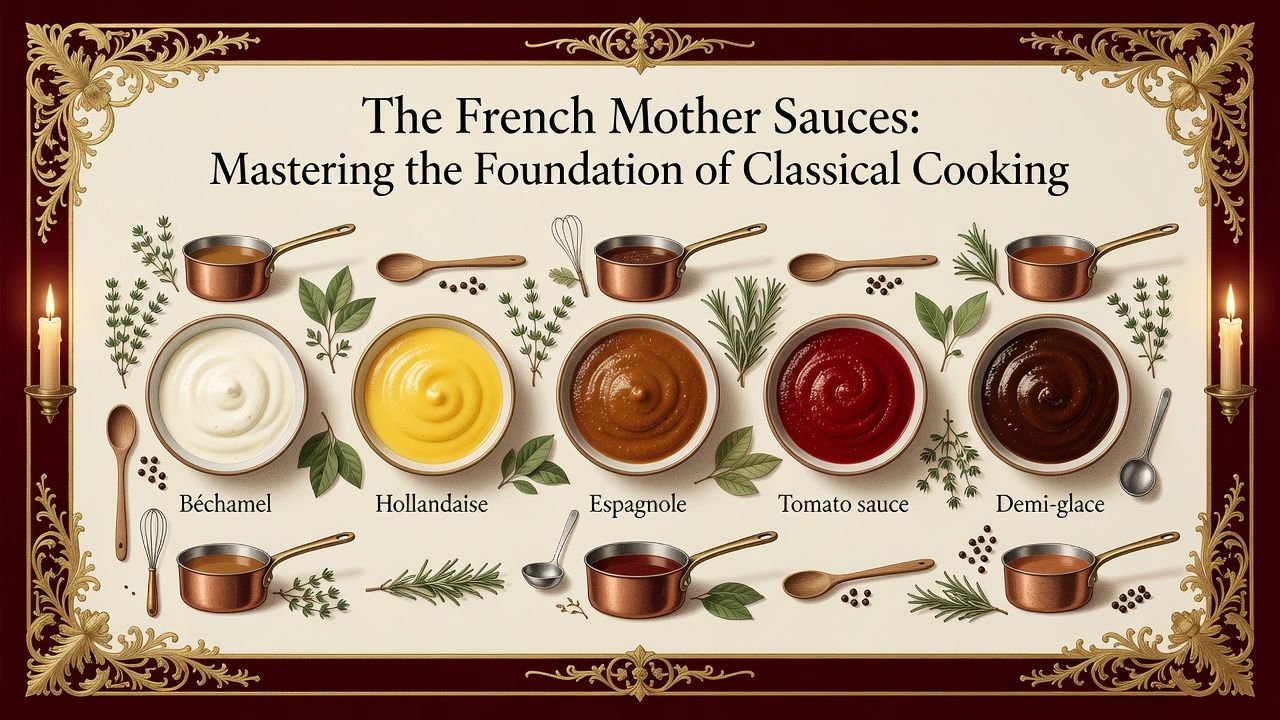
The modern canon settles on five. Three are thickened with roux — a cooked paste of equal parts fat and flour — one is thickened by reduction and gelatin, and one is an emulsion held together by egg yolk. Their differences matter less than their family resemblances:
| Mother sauce | Liquid + thickener | Classic children |
|---|---|---|
| Béchamel | Milk + white roux | Mornay (cheese), soubise (onion), crème (cream), mustard sauce |
| Velouté | White stock (chicken, veal, fish) + blond roux | Suprême, allemande, sauce vin blanc, poulette |
| Espagnole | Brown stock + brown roux + tomato & mirepoix | Demi-glace, bordelaise, chasseur, Robert, madère |
| Tomato | Tomato, reduced (classically with roux and pork) | Provençale, creole, puttanesca-style variations |
| Hollandaise | Butter emulsified into egg yolk + acid | Béarnaise, choron, maltaise, mousseline |
Notice what the third column really shows: the derivatives are almost all one idea each. Mornay is béchamel plus cheese. Soubise is béchamel plus sweated onion. Béarnaise is hollandaise with a tarragon-shallot-vinegar reduction standing in for the lemon. This is the entire trick. Escoffier’s genius was less culinary invention than organizational clarity — he took a sprawling repertoire and revealed that it was a family tree. Learn five trunks and the branches take care of themselves.
Roux: the technique inside three of the five
Roux is flour cooked in fat, and it does two jobs at once. The starch granules in the flour are what will eventually swell and thicken your liquid; the cooking in fat coats those granules so they disperse instead of clumping, and simultaneously toasts away the raw, pasty flavor of uncooked flour. How long you cook it changes everything. A roux cooked only a minute or two stays pale and thickens powerfully. A roux cooked until it smells like toasted nuts and turns the color of peanut butter tastes vastly better but thickens noticeably less, because the prolonged heat begins breaking those starch chains down. This is a genuine trade-off, not a preference, and it explains why the darkest sauces need the most roux by volume.
| Roux stage | Cook time | Thickening power | Use for |
|---|---|---|---|
| White | 2–3 min, no color | Strongest | Béchamel, cream soups |
| Blond | 5–8 min, pale gold | Strong | Velouté, gravies |
| Brown | 15–25 min, nutty aroma | Moderate | Espagnole, brown sauces |
| Dark / chocolate | 30–45 min, deep brown | Weakest | Gumbo and Cajun cooking |
The one rule that prevents nearly all lumps is a temperature difference between roux and liquid. Add cold or cool liquid to hot roux, or warm liquid to cooled roux — just don’t combine two things that are both piping hot, which sets the starch instantly on contact and traps flour in the middle of the clumps. Add the liquid in stages, whisking each addition to a smooth paste before the next, and thin gradually. And whatever the sauce, simmer it for at least ten minutes after it thickens: starch needs that time to hydrate fully, and a sauce that tastes faintly of raw flour is almost always a sauce that was rushed.
The ratio worth memorizing
For every 500 ml of liquid: about 30 g each of fat and flour gives a light, nappé sauce that coats a spoon; 45 g each gives a medium sauce for gratins; 60 g each gives a thick base for soufflés and croquettes. Everything else is seasoning.
Béchamel and velouté: the same sauce, different liquid
Béchamel is milk thickened with white roux, and it is the sauce most home cooks already make without knowing its name. Warm the milk, make the roux, combine, simmer gently, season with salt, white pepper, and — traditionally — a scrape of nutmeg and an onion studded with a clove and a bay leaf left to infuse. The nutmeg is not decoration; a very small amount does something specific to dairy, lifting it out of flatness without announcing itself. Strain, and you have the base of every gratin, croque monsieur, moussaka, and lasagna you will ever build. Add gruyère and parmesan and it becomes mornay, which is to say: it becomes the sauce that makes macaroni and cheese worth eating.
Velouté is structurally identical, with white stock replacing the milk and a blond roux replacing the white. That single substitution changes the sauce’s entire character, because now the flavor is carried by the stock rather than by dairy — which means velouté is only ever as good as what you pour into it. This is the sauce that punishes bad stock and rewards good stock more directly than any other, and it is the reason classical kitchens obsess over stock-making. Finish a chicken velouté with cream and a little lemon and you have sauce suprême; finish it with a liaison of egg yolk and cream and you have allemande. Both are five minutes of work on top of a base you already made.
Espagnole and the long road to demi-glace
Espagnole is the most demanding of the five and the most transformed by modern practice. Classically it is brown stock — made from roasted bones — thickened with brown roux, deepened with tomato and a browned mirepoix of onion, carrot, and celery, then simmered for hours and skimmed relentlessly. Reduce it further with more brown stock and you get demi-glace, the glossy, profoundly savory reduction that underlies bordelaise, chasseur, and most of the classical meat sauces. It is a genuine project, and there is no honest way to pretend otherwise.
Many contemporary kitchens have quietly abandoned the roux here, preferring a jus lié: a well-made brown stock reduced until the natural gelatin from the bones provides all the body needed, sometimes tightened at the last moment with a slurry of arrowroot or cornstarch. The result is cleaner, glossier, and less heavy, and most modern palates prefer it. Both approaches are legitimate; understanding espagnole matters because it teaches you what roasted-bone depth tastes like and how skimming affects clarity. If you make it once and never again, you will still cook differently afterward.
Hollandaise: the emulsion that teaches everything
Hollandaise is the outlier and the most instructive. There is no starch here at all — instead, egg yolk acts as an emulsifier, its lecithin allowing melted butter to be suspended in a small amount of water and acid rather than separating out. You whisk yolks with a splash of water and lemon juice or a vinegar reduction over gentle heat until they thicken and lighten (the sabayon stage), then add warm butter in a thin stream, whisking constantly, until the sauce becomes thick, glossy, and pourable. Season, and serve promptly.
Every hollandaise failure is a version of the same two problems. Too much heat scrambles the yolks — work over barely simmering water, off the heat as needed, and never let the bowl touch the water. Too much butter too fast overwhelms the emulsion and it breaks, separating into greasy pools. The fix for a broken sauce is elegantly simple: start a fresh yolk with a teaspoon of water in a clean bowl, whisk it to a sabayon, then whisk the broken sauce into it slowly, as if it were the butter. Understanding this rescue is understanding emulsions in general, which is why the same move saves a split mayonnaise or beurre blanc.
Hollandaise does come with a genuine food-safety consideration worth stating plainly: it contains egg yolks that are warmed but not fully cooked, and it is held at temperatures that are hospitable to bacteria. Use fresh, properly refrigerated eggs, consider pasteurized eggs if you are serving anyone pregnant, elderly, very young, or immunocompromised, make the sauce close to service rather than hours ahead, and don’t hold it lukewarm on the counter. Current guidance on egg handling and safe holding temperatures is available from FoodSafety.gov and the USDA’s Food Safety and Inspection Service, and it is worth a two-minute read before you make hollandaise for a crowd.
Where to start, and what you actually gain
Begin with béchamel, because it is forgiving and immediately useful, and make it three times in a week — once thin, once medium, once thick — so the ratios live in your hands rather than in a notebook. Move to velouté next, which teaches you to taste stock critically. Then hollandaise, which teaches emulsion and rewards practice more than any of the others. Tomato sauce and espagnole can wait; by the time you reach them you will already have absorbed the underlying grammar. Work in small batches, taste constantly, and season in stages rather than at the end, because a sauce that reduces concentrates its salt along with everything else.
What you gain from this is not a repertoire of French dishes. It is a mental model. You will start seeing that a Japanese curry roux and a Cajun gumbo base are the same technique pushed to different colors, that a cheese sauce and a queso and a fondue are answering the same structural question in three ways, that the cream sauce clinging to your pasta and the gravy on your roast are cousins. Food scientists at organizations like the Institute of Food Technologists describe the same phenomena in terms of starch gelatinization and emulsion stability; the classical kitchen arrived at the identical knowledge through two centuries of stubborn repetition and gave it names you can say out loud. Learn the five mothers, and the next time a recipe tells you to whisk something into something else, you will already know what is about to happen — and, more usefully, what to do when it doesn’t.