Kitchen Design & Organization
Professional kitchens don’t organize for beauty. They organize so that anyone can find anything, first time, under pressure — and that principle scales down beautifully.
There is a specific kind of domestic misery familiar to almost everyone: standing in front of an open cupboard, holding a hot pan, unable to find a lid. Or discovering a bag of something unidentifiable and undated at the back of the freezer. Or buying a third jar of cumin because the first two were invisible behind the flour. These aren’t failures of tidiness — a kitchen can look immaculate and still work like this. They’re failures of system, and professional kitchens solved them decades ago out of pure necessity, because a cook who can’t find something during service costs the whole line.
The professional approach rests on three ideas that sound obvious and are almost universally ignored at home. Everything has a designated place and returns to it. Everything is visible or clearly labeled, because searching is waste. And stock rotates, so the oldest gets used first rather than migrating to the back to die. None of this requires expensive organizers or a renovation. It requires deciding where things live, and then being slightly stubborn about it for about three weeks until it becomes automatic.
Principle one: store by use, not by category
Most domestic kitchens are organized taxonomically — all the glassware in one cupboard, all the ceramics in another, all the “cooking things” in a third. This is how a shop displays inventory, and it’s a poor fit for how cooking actually happens. Professional kitchens organize by station: whatever a task requires lives where that task is performed, even if that means the same category of object appears in three different places.
Applied at home, this means pans and cooking oils and your salt cellar and tongs live beside the hob. Boards, knives, peeler, scale, and mixing bowls live at your main prep counter. Everyday plates, bowls, cutlery and glasses live in whichever cupboard is closest to the table or the dishwasher — not wherever they’ve historically been. Baking equipment clusters together because baking is a distinct activity. Cleaning supplies live under or beside the sink. Accept the apparent duplication: keeping measuring spoons in two places, or a second set of salt and pepper at the table, is not disorganization, it’s a deliberate trade of a few pounds of equipment for hundreds of saved steps a month.
Layer frequency on top of this. Prime real estate — the counter-height shelf, the front of the drawer, the eye-level cupboard — belongs to daily items. Weekly items go one tier out. Seasonal and rare items go high, low, or out of the kitchen entirely. Most people have their frequency map exactly inverted somewhere: the roasting tin used four times a year sitting at eye level while the everyday skillet lives in a bottom corner behind three other pans.
Principle two: if you can’t see it, you don’t have it
Visibility is the professional obsession that home kitchens most consistently miss. In a commercial kitchen, dry goods sit in identical clear containers, labeled and dated; prepped items sit in labeled deli containers; nothing is stored in a mystery bag. This isn’t fussiness. Invisible inventory gets forgotten, duplicated, and eventually thrown away, and that’s true in a domestic pantry too — the half-used bag of lentils folded shut behind the pasta has effectively ceased to exist.
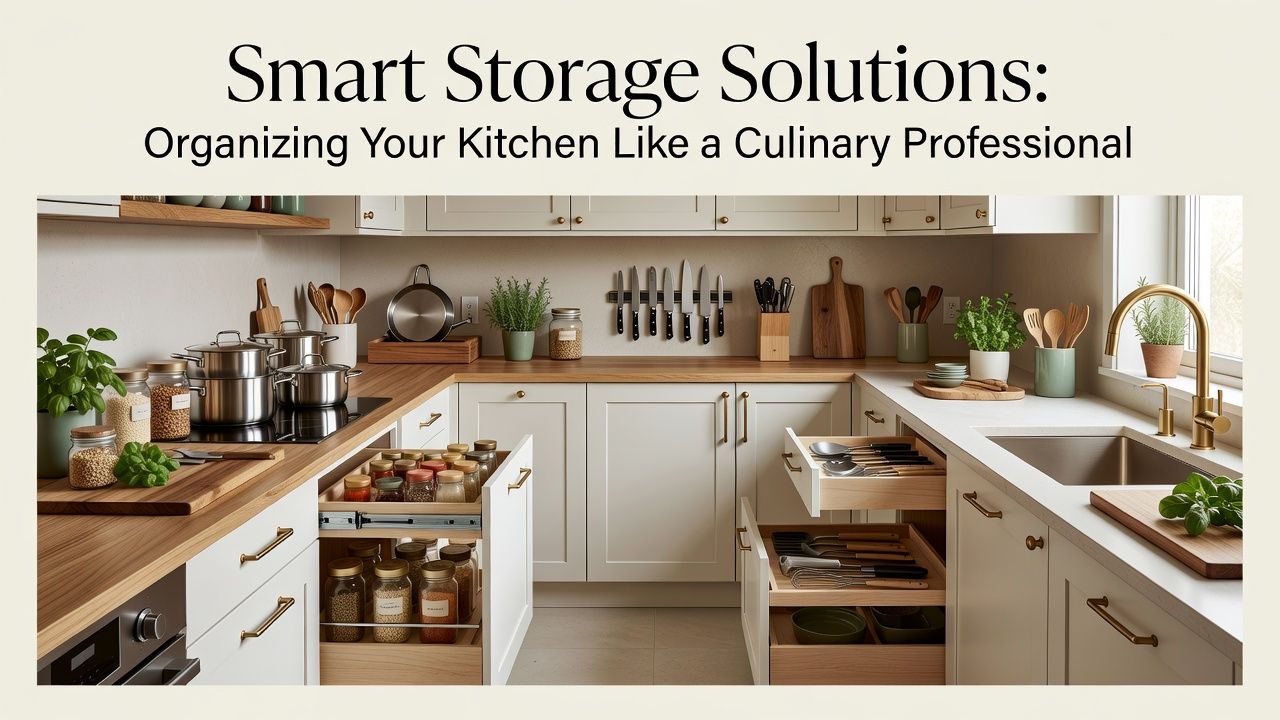
Decanting dry goods into uniform clear containers does four things at once: you can see what you have and how much, the containers stack squarely instead of slumping, contents stay fresher and better protected from pests, and shelf depth stops being wasted by half-empty packets. Label everything with contents and date — masking tape and a marker is entirely sufficient, and cheaper than any labeling system. For deep cupboards, turntables and pull-out baskets bring the back forward. For drawers, dividers and in-drawer organizers stop utensils from becoming an unsearchable tangle. And where possible, prefer drawers to cupboards for pots, pans, and food storage, because a drawer presents its entire contents at once while a cupboard hides everything behind the front row.
| Storage problem | Professional fix | Cost |
|---|---|---|
| Lid chaos | One matched container system; lids filed upright in a bin | Low |
| Buried spices | Tiered rack, drawer insert, or magnetic tins; label the tops | Low |
| Dead air in cupboards | Shelf risers and stacking shelves to recover vertical volume | Low |
| Unreachable corners | Turntables; pull-out corner units if renovating | Low–high |
| Utensil tangle | Drawer dividers; wall rail with hooks for the daily few | Low |
| Mystery freezer items | Label everything with contents + date; flat-freeze in bags | Almost none |
FIFO: first in, first out
The single most valuable habit borrowed from professional kitchens. When you unpack shopping, move the older stock to the front and put the new behind it. Thirty seconds per shop, and it very nearly eliminates the forgotten-jar-at-the-back problem that drives most household food waste.
The refrigerator: where organization becomes safety
Fridge organization is the one area where getting it right matters for more than convenience. The single most important rule is placement of raw meat, poultry, and fish: these belong on the lowest shelf, in a sealed container or on a tray, so that nothing can drip onto ready-to-eat food below. This one arrangement prevents the most common form of domestic cross-contamination, and it costs nothing to implement.
Beyond that, the fridge has real temperature zones and using them well extends the life of everything. The back and lower shelves run coldest; the door is the warmest and most temperature-variable part, which is why it’s a poor place for milk and eggs despite manufacturers moulding shelves for exactly those items — condiments and pickles, which are far more robust, belong there instead. Crisper drawers control humidity: high humidity suits leafy greens and most vegetables, lower humidity suits fruits that give off ripening gases. And don’t overfill; cold air needs to circulate, and a jammed fridge runs unevenly. Keep an appliance thermometer inside and aim for the recommended range — detailed guidance on safe refrigerator and freezer temperatures, and on how long different foods keep, is published at FoodSafety.gov and by the USDA’s Food Safety and Inspection Service.
Two organizational additions make an enormous practical difference. Clear bins that group categories — dairy, condiments, snacks, prepped vegetables — let you pull out a whole section rather than excavating, and make cleaning trivial. And an “eat first” bin at eye level, holding leftovers and anything approaching its limit, converts the fridge from a place where food quietly expires into a place where it gets used. Label leftovers with the date they were made; memory is unreliable and guessing is how good food gets binned unnecessarily and how questionable food gets eaten.
Pantry: rotation, containers, and knowing what you own
A working pantry needs three things: uniform containers, honest labels, and rotation. Group by type — grains and pasta together, tinned goods together, baking supplies together, oils and vinegars together — and within each group, arrange so labels face out and older stock sits in front. Airtight containers matter more than people assume for flours, grains, nuts, and anything with fat content that can go rancid; nuts and whole-grain flours in particular are much better kept in the fridge or freezer if you don’t get through them quickly.
Spices deserve particular attention because they’re the most commonly mismanaged pantry item. Ground spices lose their aromatic punch within roughly six to twelve months and whole spices last considerably longer, so buying enormous jars of ground spice you use twice a year is false economy. Store them away from heat and light — the rack directly above the hob is the traditional and worst possible location, since heat accelerates their decline. Label the lids if they’re stored in a drawer, arrange alphabetically or by cuisine, and do a periodic smell test: a spice that smells of nothing will taste of nothing, and no quantity compensates.
| Item | Store it | Common mistake |
|---|---|---|
| Ground spices | Cool, dark, airtight; buy small | Big jars stored above the hob |
| Nuts & seeds | Fridge or freezer, sealed | Warm cupboard — they go rancid |
| Whole-grain flours | Cool or refrigerated, airtight | Treating them like white flour |
| Oils | Dark, away from heat | Clear bottle beside the stove |
| Potatoes & onions | Cool, dark, ventilated — separately | Stored together; both spoil faster |
| Bread | Room temp short-term; freeze sliced | Refrigerating it — it stales faster |
The freezer, used properly
The freezer is the most underused storage asset in most homes, largely because it becomes an archaeological site rather than a working larder. Two habits fix it. First, label everything — contents and date, without exception — because frozen food is genuinely unidentifiable after a month and undated food gets thrown out on suspicion. Second, freeze flat: liquids and portions in freezer bags, laid flat until solid, then filed upright like books. Flat packages freeze faster, thaw faster, and store in a fraction of the volume of tubs.
Beyond that, keep a running list of freezer contents somewhere visible — a note on the door works fine — and portion things before freezing so you can take out exactly what you need rather than defrosting a block. Freeze in useful units: single portions of stock, flat-packed mince, sliced bread you can take a slice at a time. And follow safe thawing practice: in the refrigerator, in cold water, or in the microwave, rather than on the counter, and cook or refrigerate promptly afterwards. Freezing keeps food safe more or less indefinitely but quality declines, so rotation applies here too — the point of a freezer is to be a working inventory, not a graveyard.
Making the system stick
Organizing a kitchen once is easy; keeping it organized is the actual problem, and professional kitchens solve it with two mechanisms worth stealing. The first is the daily reset: at the end of service, everything is cleaned and returned to its designated position, so the next shift starts from a known state. At home this is fifteen minutes after dinner — wipe down, put things back, run the dishwasher — and it’s the difference between a system that survives and one that degrades within a fortnight. The second is that designated positions are genuinely designated, not approximate. If the tongs live on the left hook, they live on the left hook, and they go back there rather than in the nearest drawer.
Add two periodic passes. A weekly ten-minute reset before shopping, where you check what’s actually in the fridge and pantry, pull anything approaching its limit into the “eat first” zone, and plan around it. And a seasonal deeper edit — every few months, work through one zone at a time, remove what’s expired or unused, and adjust placements that aren’t working. Doing it zone by zone rather than attempting the whole kitchen in one heroic afternoon is what makes it sustainable.
If you want a place to begin, start with the fridge, because it delivers the fastest visible payoff and the safety improvement is real: raw meat to the bottom shelf, clear bins by category, an eat-first zone at eye level, dates on the leftovers. Then do the spice storage, then one drawer, then the pantry containers. Within a month the kitchen stops fighting you — and the quiet benefit nobody anticipates is that when you can see everything you own and find it instantly, you cook more, buy less, and throw away considerably less than you used to.