Global Culinary Traditions
A cook who has made the same dish twenty thousand times, on one burner, for people who will notice immediately if it’s wrong. That’s not lesser cooking — it’s a different and often harder discipline.
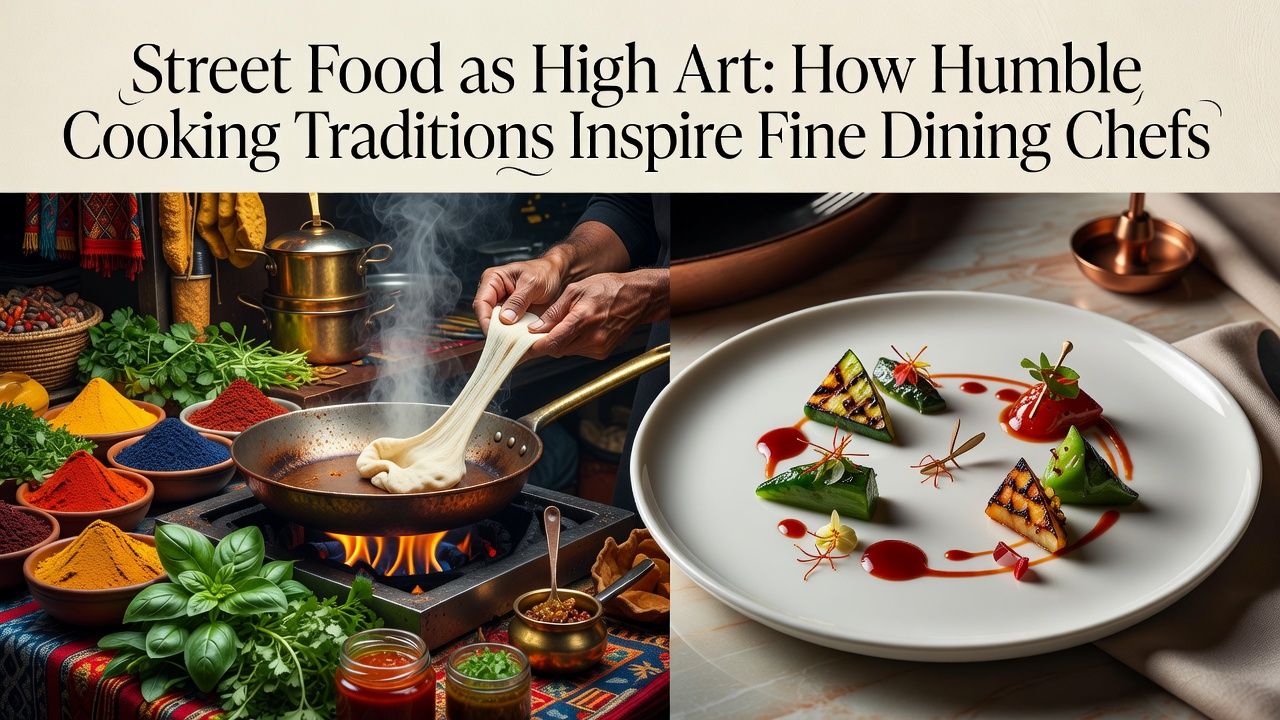
There’s a hierarchy built into the way most people talk about food, and it runs from the street cart at the bottom to the tasting menu at the top. It’s worth examining, because a great many chefs at the supposed top of that hierarchy don’t believe it. Ask cooks with international reputations where they’ve eaten best and the answers skew overwhelmingly toward markets, hawker centres, roadside grills, taquerías, and stalls run by people who have been making one thing for thirty years. That’s not populist posturing. It reflects a genuine professional judgment about where certain kinds of excellence actually live.
The judgment rests on a specific observation. A fine-dining kitchen has enormous resources — equipment, staff, budget, the freedom to source anything — and uses them to execute complexity. A street vendor has almost none of those things and instead has repetition: the same dish, made thousands of times, refined by immediate and unforgiving feedback from customers who eat it weekly and will simply walk to the next stall if standards slip. Those are different paths to quality, and the second one produces a kind of mastery the first cannot easily buy. Understanding why is genuinely useful for anyone who cooks.
What repetition actually buys
Specialization is the defining feature of great street food. A stall sells one thing, or a very small number of related things. That means the cook isn’t managing a menu of forty items across five techniques — they’re making the same dish, hundreds of times a day, for years or decades, with every variable pushed toward optimization. The dough hydration, the grill temperature, the exact moment of doneness, the sequence of assembly: all of it has been tested empirically thousands of times by someone whose livelihood depends on the outcome.
The feedback loop is the other half. A street vendor’s customers are regulars, often daily, and they are experts in that one dish through sheer accumulated exposure. They notice immediately if the balance is off, if the portion has shrunk, if today’s batch isn’t right — and they simply go elsewhere, because there are three alternatives within fifty metres. This is a brutally efficient quality mechanism, more immediate than any review system, and it operates on the vendor every single day. What survives it tends to be very good.
Constraint contributes too. One burner, limited storage, no walk-in refrigeration, no brigade, ingredients that have to be sourced fresh daily because there’s nowhere to keep them. These aren’t romantic limitations — they’re real operational difficulties — but they force a discipline that abundant resources don’t. Everything must be efficient, nothing can be wasted, and the technique has to work reliably at speed with minimal equipment. The result is cooking stripped to what actually matters.
| Dimension | Fine dining | Great street food |
|---|---|---|
| Range | Broad menu, frequently changing | One dish, refined over decades |
| Path to quality | Resources, sourcing, technical complexity | Repetition and immediate feedback |
| Feedback | Critics, guides, occasional diners | Daily regulars who are experts in that dish |
| Constraint | Few — abundance is the norm | Severe — and clarifying |
| Knowledge transfer | Training, documentation, professional networks | Family and apprenticeship, often undocumented |
Recognition, and its complications
The status shift over the past two decades has been real. Major restaurant guides have awarded stars to hawker stalls and tiny street operations; street food traditions appear on UNESCO’s intangible cultural heritage lists at ich.unesco.org, with Singapore’s hawker culture recognized as a living community practice; UNESCO’s Creative Cities network includes cities designated for gastronomy, several celebrated principally for their street and market food; and awards bodies including the James Beard Foundation have increasingly recognized taquerías, delis, and neighbourhood institutions alongside white-tablecloth restaurants. Documentary series have made individual vendors internationally famous.
This recognition is deserved and also complicated, which is worth saying plainly. Attention brings queues, rising rents, and pressure to scale — and scaling is precisely what street food is bad at, since the quality depends on one person making a limited number of portions. Vendors who become famous sometimes find the thing that made them worth visiting is the first casualty of visiting. Meanwhile the hawker and street-vending trades face genuine structural pressures in many cities: regulation and licensing costs, redevelopment, an aging generation of vendors whose children reasonably prefer less punishing work, and gentrification that prices out the operations that gave a neighbourhood its character. UNESCO recognition of hawker culture was sought partly because of these threats, not merely to celebrate.
There’s also an uncomfortable pattern worth naming: dishes that are cheap and unglamorous when made by the communities they come from frequently become expensive and celebrated when reinterpreted elsewhere, with the profit and prestige accruing to the reinterpreter. That’s not an argument against chefs drawing on street food — borrowing is how cuisine has always worked — but it does suggest that credit, sourcing, and where the money goes are fair things to think about.
How to find the good stall
The heuristics travelers converge on are consistent: go where locals queue, prefer stalls selling one thing over those with long menus, favor high turnover (it means fresh ingredients and food that hasn’t sat), and watch the food being cooked to order in front of you. Eat at busy times for the same reason. These same signals happen to correlate with both quality and food safety.
What fine dining actually takes from it
The influence flows in several directions, and it’s more than menu inspiration. Chefs borrow specific dishes and reinterpret them — the elevated taco, the refined bao, the tasting-menu noodle course — with results ranging from genuinely inventive to slightly embarrassing. More interestingly, they borrow techniques: high-heat wok cooking, live-fire grilling, the specific charring and smoke management of street grills, the layered assembly of a properly built sandwich or bowl.
The deepest borrowing, though, is philosophical. A number of celebrated restaurants have moved toward exactly the model street food already used: a very short menu, sometimes a single dish, executed with obsessive repetition. Counter seating where diners watch the cooking. An emphasis on immediacy — food served the moment it’s finished rather than plated and carried. A rejection of elaborate presentation in favor of getting one thing exactly right. These were street-food principles long before they were restaurant trends, and the traffic in ideas is more honest when it’s acknowledged as such.
The great traditions, briefly
| Tradition | Its particular genius |
|---|---|
| Mexican taquerías | Specialization by filling; masa handled properly; salsa as a discipline |
| Thai street cooking | Balance of hot, sour, salty, sweet adjusted per portion, in seconds |
| Singapore & Malaysian hawker centres | Many cuisines side by side; multi-generational single-dish stalls |
| Indian street food | Layered textures and chutneys; regional chaat repertoires |
| Middle Eastern grills & bakeries | Bread as the vehicle; charcoal management; herbs and acid |
| Japanese yatai & yakitori counters | Precision over a small grill; using every part of the bird |
| West African roadside cooking | Grilled and fried staples with complex spice pastes and pepper sauces |
A brief practical note for travelers, since street food is a common source of anxiety: the sensible precautions are the ordinary ones — prefer food cooked thoroughly and served hot in front of you, favor busy stalls with high turnover, be more cautious with raw items and with drinks and ice in places where water quality is uncertain, and wash or sanitize your hands. Country-specific travel health guidance is published by the Centers for Disease Control and Prevention and is worth checking before a trip. Anxiety is not the same as caution, and the busiest stall in a market is usually a better bet than an empty air-conditioned restaurant.
What a home cook should take from this
The transferable lesson is about depth rather than breadth. Most home cooks improve by cooking more different things; a surprising number would improve faster by cooking one thing repeatedly. Pick a dish you love — not a project, an everyday dish — and make it twenty times over a couple of months, changing one variable at a time and paying attention. The gains from that are qualitatively different from cooking twenty different recipes once each, because you start to notice things that only become visible through repetition: how the pan behaves, how the timing shifts with the ingredients, what actually matters and what you’d been doing out of habit.
The related lesson is that constraint is generative rather than limiting. Street vendors produce extraordinary food with one burner and no equipment, which ought to permanently retire the idea that better cooking requires better gear. Getting the fundamentals right — heat control, seasoning, timing, ingredient quality — matters more than anything you could buy, and a cook who can make one thing brilliantly on a single flame has a more useful skill than one who owns a great deal of equipment and makes many things adequately.
And the last one is about how we assign value. The framing of street food as “humble” cooking that fine dining “elevates” gets the relationship backwards more often than not. These traditions represent generations of accumulated technical knowledge, refined under the harshest possible feedback conditions, frequently by people with no other economic option and no institutional recognition. That’s not raw material awaiting improvement — it’s finished, expert work that happens to be sold cheaply. The chefs who understand this best are the ones who go and eat there, repeatedly, and come back saying they learned something. It’s worth doing the same.